Friday, August 26, 2011

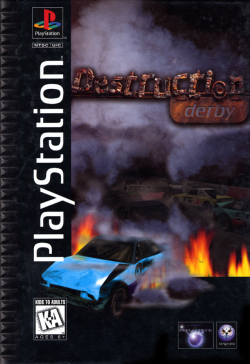
PS1 - Destruction Derby

Haiku-Review:

crude smash 'em up fun
packed in a next-gen racer -
"you've blown your engine!"

Additional Comments:

I remember when I first got my PS1, two of the first games that came into my possession were Formula 1 (which was, and still is a fantastic racing sim in my opinion - besides, it was based on the '95 season, which I'll admit didn't have the pizzazz of preceding seasons with the likes of Senna and Prost; it stirred up some fantastic battles between Benetton and Williams - oh, to see Williams in its prime again, but alas, that's all for another day) and Destruction Derby 2. Having always enjoyed racing games, I was ecstatic when I found a game based around the concept of, well...demolition derbies - reminded me of when I used to go watch Figure-8 races as a kid. Not only could I race around some interestingly designed tracks, but I could also violently ram my opponents and watch the parts fly as they spin around mercilessly. Fantastic! Of course, nowadays with franchises like Forza and Gran Turismo, car modeling couldn't look better, the racing couldn't get any better (well, it could, but I digress), and with Forza introducing crash damage; these old-timey racers are just so horribly outdated now. The graphics and 3D modeling are puke, the tracks leave much to be desired and the opponent AI is damn near absent - although, at least it's not as bad as Mario Kart AI - sheesh, talk about some awful stuff. But just like any other game of yore, those games that were great are going to continue to shine for one reason or another, no matter how much they look like a pile of crap compared to today's standards.

But then there's Destruction Derby. Based on my initial reaction to Destruction Derby 2 back in the day, I'm pretty confident that this game would have had the same effect - after all, we're talking about an overall upgrade from the measly offerings of arcade-style racers or driving sims we had available to us; stuff like Out Run, F-Zero, Virtua Racing, or heck, Super Mario Kart. Well, truth be told, none of those games are measly - they're all fantastic! Come on, Virtua Racing? I remember dropping a wealth of quarters anytime I saw one of those twin machines at an arcade. As far as driving/racing games went, that game was the bomb! Nevertheless, the next-gen consoles forever changed the world of racing games. Sure, Virtua Racing was using 3D models, but compared to some of the next-gen stuff, it was obvious that 3D was still in its infancy. To me, playing Destruction Derby today, while the game isn't the greatest (which I'll get into why in a bit), there's this real sense of control (and/or lack of), speed and realism, despite that realism being nothing more than shards of quadrilateral polygons flying across the screen compared to today's games. Of course, I haven't played Virtua Racing since the mid 90s, so my argument could be completely bogus. But I'm not here to talk about the king of arcade racing, so moving on....

I have to be honest, it's hard to admit that the game is inherently great, because compared to its sequel, it's a piece of shit. However, erasing all prior knowledge and experience of its sequel, I have to default to the game's graces. It's a game based around real pedal-to-the-metal racing, crash-based spin-those-suckers-out racing and classic arena style derbies, and it delivers on all fronts. The racing is great (although I'd have to call shenanigans on Rookie mode), and the crash 'em, smash 'em action is a blast, well almost - the arena battles can become a bore and the idea of including six rounds of the same arena in championship mode is a snooze fest. But again, this can almost be attributed to knowing how the sequel handled it. So then, are the arena championships actually a dud? Eh, I'm still gonna say yes.

Looking at the different modes, Stock Car has always been my favorite, despite the game focusing on and awarding those who perform the biggest wrecks. While Wreckin' mode is a lot of fun, I've always liked trying to cross the finish line in first while total chaos ensues around the track. In Wreckin' mode, laps and/or position just doesn't really matter and you can tank the entire race, ramming others incessantly for points. Yea, that's the point of Wreckin' mode, but it really defeats the "racing" aspect of the game that I'd like to think should still remain a part of it. But what I enjoy about Stock Car mode is that the "crash" aspect isn't negated. Everyone's still out to spin you into oblivion and you can drop from first to last at the drop of a hat if all goes wrong, but that's part of the fun. And unlike games like Mario Kart where the same scenario can have you throwing remotes and swearing at the TV, this game never instills that brand of frustration thanks to the division brackets.

The idea of divisions is another aspect I've always like about this series. Although you're racing nineteen other drivers on course, in reality, you're only racing three other drivers for championship contention at any one time. But to win the overall championship, you have to win each division and work your way up the league ladder. And to help ease the idea of having to race five separate divisions one after another just to win the overall, each division pits you against a unique set of tracks. While the sequel made better use of this idea (no surprise), the original game did manage to switch up the tracks for each season enough to alleviate any potential boredom. Each location remains constant, but the track layouts consistently change with each new season with the exception of Crossover (ok, there is a slight change but it's ever so slight). But come on, who's going to complain about a track that gives you twenty chances per race to t-bone your opponents dead on? This is what Wreckin' racing is all about! Although, damn, does that track suck ass in Stock Car mode.

The tracks themselves aren't the greatest, but they get the job done. There's really only two types of layouts: ovals (or tri-ovals) and narrow street courses. While they're nothing to lick your lips over, they work for the style of racing the game offers: close-quarters, paint-grinding, fender-bending action. Some of the tracks however, especially Ocean Drive or the crossover version of Cactus Creek, are a nightmare to throw your car around when you're behind the wheel of the Pro machine. Some of those right-angled corners are just stupidly tight and you have a higher chance of blowing your engine from ramming the barrier than some of the other louts out there - looking at you Learner Driver.

In addition to the aforementioned Rookie and Pro modes, there's also an Amateur mode. I suppose these can be labeled as difficulty modes, however I've never really viewed them that way. For one, Pro has always been my favorite mode in DD2, and I think it's safe to say that it's also the case here. Pro really frees up the car, to the point where you literally have no control when zipping around corners and performing tight radius turns, while much easier to pull off, can turn into an unwanted spin real fast But despite this total lack of control, in a way, you actually have more control over cornering - it's a bit hard to explain. Sure, speed is more apparent in the latter modes, but outside of Rookie, speed means very little. Unfortunately, the lack of speed in Rookie makes Rookie the hardest mode to handle, especially when doing Stock Car racing. I think the other reason Rookie comes off as the "hard" mode to me is that it seems that the AI doesn't really change between difficulty modes. The only thing truly affected is the physics of the car. Oh, and because of Pro's lucid control, the arena matches do become a bit livelier.

I'm not completely sure what was the first game that introduced me to a rather "alternative" take on video game music, but I know DD2 was one of the first. Despite it's completely non-vgm style soundtrack, I liked it. I was glad to hear that the original game also had a similar approach to its soundtrack. Compared to your average video game, this stuff is just...strange, but damn is this music great. Typically, I hate game soundtracks that have a more rock/techno edge or similarly styled radio-friendly aesthetic - thinks Sonic Heroes and other Crush 40 bullshit - or even use commercial music, although Summer Song somehow seemed fitting in Formula 1. Anyways, a couple of tracks worth noting are Aftershow and Hardhitter.

Overall, the game's good, but great? Eh, based on my original impressions of DD2, it could have been, but we'll never know for sure. Unfortunately, as I've said, it's not the one I started out with, and compared to the sequel it falls horribly short so my perception of it is highly skewed. It's a mixed bag for me. I know the material presented is worthy, but knowing the potential of what was to come - it's like trying to explain why Super Mario Bros. is such a great game when you know all and well that compared to its successors, it just sucks balls.

Nano-Rant:

The Skum is an asshole!

Rating: 2.5 Smoothies out of 5

Friday, August 19, 2011

Tears of Joy

Today, or more appropriately, yesterday, Beat All Games has turned the final page of its annual calendar. That's right, one year had passed since I started this mess - though technically, that page was turned late last month. Personally, I'm amazed I've stuck with this, even if I have slowed down considerably in the last few months and we haven't heard wind of Sven. Sadly, the amount of games beaten is few, but so what? I've had fun, and like I said in the beginning, I'm doing this all purely for my own amusement, so who cares? And if someone pops their head in and reads a few of these things; has a chuckle or the urge to give me the bird, all the better!

While Sven hasn't been seen around these parts, I still chat with him about games pretty regularly and we often have a laugh about this site, mostly in regards to how the site grew from an idea of shooting off a couple comical lines about either our fondness or disgust of a game we've recently beaten into full-length critical essays tearing the games apart from both a player's perspective and a technical perspective if and when possible. Not sure how that happened myself, but it's interesting nonetheless that such an evolution even took place - although I'm fairly certain I can attribute that to the fact that both of us are writers at heart. Heck, even now I'm probably writing far more than I should be just to say "Happy Anniversary, Beat All Games!"

And so, with the passing of a year, I look at the almighty lists. Drat! I've managed to rack up only 61 games beaten, with 84 standing as the total between Sven and myself. I'd say it's a tad on the short side, but then, this isn't a competition. It's something done completely at our leisure, for our leisure, so again, who cares? I still have a large number of games in process, though I don't really want to divulge anything. And I might have a new partner in crime hopping on board who has recently had the desire to run through a lot of computer games, both new and old. It seems he's got some stuff on his mind he'd like to say about some of those games, so why not? Besides, it helps me out by not having to play them myself, since I'm not the biggest fan of computer games.

Anyways, enough chit chat. I thought I'd post my top 5 favorite and least favorite games that I played over the past year. Be aware that I'm posting these games pretty much at the tip of a hat, so I'm likely overlooking some fantastic games and/or lurid atrocities. And if that's the case, well, then maybe they didn't deserve to be in the list to begin with, because obviously I couldn't remember them under pressure of a snap decision. So, without further ado I present my five's, in descending order; each number showcasing a favorite and not-so-favorite:


5. Do-Re-Mi Fantasy: Milon no DokiDoki Daibouken
-I'm a bit guilty that I might have picked Do-Re-Mi Fantasy because it's one of those hidden Japanese gems that I would have never known about were it not for the world of emulation. But then, the game is just fantastic. It's one of those games that shines because of its simple nature. They didn't fluff it with needless crap. Everything in the game serves its purpose and serves it well.

5. Drakkhen
-While I don't think this game deserves to be so down-voted - it had so many great ideas with serious potential - there were just way too many flaws in this game. Seriously, this game was a total and complete mess from start to finish, and that's just sad.


4. The Bard's Tale
-I still think this is a very underrated game. Ok, maybe it's not the greatest hack 'n slash out there, but for me there's something about this game where all the pieces just fall into place. Heck, I really had to dig to even find anything to complain about.

4. Mario Pinball Land
-Like I've said numerous times already, I have a strange affinity for console-based pinball games, but this game was just far too luck-based and unfair in stage design for my tastes. While it's a fun game for about five minutes, it quickly delves into tedium for anything more.


3. New Super Mario Bros. Wii
-I feel like an idiot fanboy for plugging this game, but I'm sorry, it's awesome. Sure, this game is nothing more than a gimmick hog, but you know, sometimes gimmick hogs are simply a lot of fun. I certainly don't want to come across as someone who's easily bought in by such an approach to game design. That'd be as shallow as someone who's bought in purely by the latest and greatest graphics. But sometimes that's just the way it is.

3. Sonic the Hedgehog 2
-You don't know how much it pains me to have to include a Sonic game in my worst 5, but the level design in this game was so disgusting. This is one of those game that makes me wonder how on earth it made it past the cutting room floor. This game was equivalent to playing any number of YouTube grade user-made levels - cheap design, sketchy spritework and slapped together architecture. Just shoot me now....


2. The Legend of Zelda: A Link to the Past
-Well, it's not my favorite Zelda, but it's definitely up there. But not only that, it's up there as one of the best games ever made. Unlike most Zelda games, and what I feel really sets this one apart, is the replayability factor. For such an ability to even exist in a puzzle game speaks volumes in my book, so yea.

2. Jaws
-Despite playing this quite a bit as a kid, I guess I was just too ignorant to realize how bad it was. But the thing is, this could have been a good game. I think there's actually some potential hidden away in this game if the designers actually had an interest in designing something that was worthwhile and fun to play. Instead, we got this piece of crap. Oh well.


1. VVVVVV
-Who would have thought a no name indie game with Commodore-style graphics and incredibly simple game design would have been so goddamn fun to play? Like I said in my post, this was one of those games where I just had a blast from beginning to end. The last time that happened with a virgin game experience...honestly, I don't know. Even as much as I love NSMBW, I had lapses where I wanted to put the game down either out of boredom or frustration. With this game, that just never happened.

1. Where's Waldo?
-I don't even want to talk about this game. It's nothing but a grotesque piece of shit that should have never been made.

Tuesday, August 16, 2011

GB - The Legend of Zelda: Link's Awakening

Haiku-Review:

hold on a second -
Yoshi, dog food...who's Christine?
what am I playing?

Additional Comments:

Obviously, I've been on a Zelda kick. As soon as I finished A Link to the Past, I immediately picked up Link's Awakening, which is doubly rewarding because of how similar the two games are in play style, and well, I love LTTP so why wouldn't I love this particular title? Now, I first picked this game up about a year or so ago, and the game really confused me. Never mind all the Mario references, it took me about an hour or so before I figured out how to get the sword. Huh? Add to that the misery I faced trying to deal with the second dungeon and I eventually put it down, sort of forgetting all about it. Well, as I said, after my LTTP run I couldn't help but not pick this game up again, and boy am I ever glad I did. This game totally delivers and really impressed when you think about it - we're talking about a GameBoy game here. This is one hell of a game for that little grey brick!

Playing through it the second time, I still faced slight adversity trying to get the sword - I don't know why I keep forgetting that you can push items with the shield. And sure enough Bottle Grotto immediately gave me the bird again. Honestly, I don't even remember what it was I had to do to continue past wherever it was that I kept getting stuck. But there were two things that absolutely stumped the hell out of me: obtaining the dog food and the bird. And you know what's sickening about the whole affair is how incredibly obvious both solutions were. I spent hours, even days interacting with every single thing I could find in every single way I could imagine. Seriously, I dug holes across every square inch of the land looking for solutions - especially for that damned canned item that Sale wanted. I slashed at everything I could. I picked up rocks galore and ran into just about every obstacle I could find. Why can't I just grab the bananas straight off the crate, or better yet, knock some out of the tree? Just what is the purpose of that monkey next to Sale's house? For the longest time, I though he might be part of the key. Arrghhh!!!!

Ok, ok, so Link has access to a wizened old coot, Ulrira, via telephone who likes to drop hints. While the hints seem incredibly blatant regarding your next move, they couldn't be further from the truth. It's amazing, given how obvious they are in context, they are actually of little help. At first I questioned the developers decision to put in what can essentially be regarded as a hint and/or cheat guide, but in the end, he's nothing more than a nuisance stating what we already know. Eh, I guess he's helpful in some circumstances. After all, if it wasn't for him, I would have never tried to hunt down a can of dog food so I can obtain a bunch of bananas. Wait, this is a Zelda game, right? Why am I performing such arbitrary tasks? It's like I'm given a grocery list: dog food - check, bananas - check, a new broom - ugh. What happened to good old action adventure?

This game definitely made me scratch my head at times. So yes, for some reason, there's a long succession of trades that must be made in this game. What better may to enliven an already proven game design than with an endless chore of fetch quests? Seriously, why does this exist? I probably wouldn't mind the whole ordeal if it wasn't so pivotal to the primary story line - looking at you mermaid scale and bananas. As a side quest for perhaps a leveled item or even something like the boomerang, whatever, but with the ultimate goal being the directions through the Wind Fish's egg, I've got to question it. Now don't take all this the wrong way, it's not bad. It's just, rather tedious and seems a bit out of character for a Zelda game. Yes, I know fetch quests exist in Zelda games, but to this extent? This is stretching it a bit if you ask me.

Enough bickering about the trading game, although I will say it really helped me to test the extreme limitations of the overworld. Much like Link to the Past, the overworld is cleverly built - seemingly designed with both obstacle and required item to overcome said obstacle constantly on the designer's mind. And while the overworld proved frustrating at times, I found myself really enjoying the overall layout. If I had to nitpick anything, it would be some of the harder obstacles that you couldn't overcome until very late in the game that led to treasure rooms that only contained a multiplied rupee. For being as late in the game as it was, it came across as a disappointing treasure. Other than having to purchase some bomb replenishment every now and then, once the shovel and/or bow is bought, the store is, well...useless. And if you can manage to steal the bow, then the store is even more useless.

Overall, Link's Awakening was fantastic. It really surprised me. Honestly, a GameBoy Zelda game - I didn't have the highest of hopes the first time I had picked up the game. This time through, I was aware of its LTTP similarities, so I expected to at least get some satisfaction out of it, but I still didn't imagine it was going to be this enjoyable. Quirkiness aside - shout outs to the Mario-verse, the fetch quest trading game, other oddities - the game is pure Zelda through and through, well at least in the form of mechanics, and really made its mark in regards to what the GameBoy was capable of producing. Another quirk worth mentioning: the music. First of all, this game has some brilliant music, especially Mysterious Forest, but there's something about it that sounds so out of place for a Zelda game. It's reminiscent of the Earth Area (Day) theme from Drakkhen - you can't help but groove while listening to it, but you also can't escape that giant question mark floating just over your head. Other great tunes include Face Shrine, Southern Shrine, or even just the basic House tune. Yet even as fitting as these songs are to the adventure, they too are just an odd curio in the full scope of the Zelda universe.

But there's one final peculiarity that I must investigate. I was chatting with a friend of mine about the game, explaining its similarities to Link to the Past. Well, similar, yet wholly different. There's a noticeable absence of some very important elements: Ganon, the Triforce and heck...Zelda! So, how is it a Zelda game, I was asked. I think what I really liked about this game is that it didn't fall into the same old trap of most Zelda games. It took familiar ideas and mechanics and wrapped it around a whole new story enveloped within a [spoilers]dreamscape[/spoilers] which I think is brilliant. There was something about this game that reminded me a lot of Wind Waker in that it was a completely fresh approach to a Zelda game. Sure, the basic mechanics were akin to LTTP, but the game on a macro scale felt wholly different. I think if it held true to form and more or less was nothing but a LTTP clone, both in mechanics and story, the game would be nothing more than an advancement of play for those who truly enjoy LTTP as opposed to a game unto its own. Although, yea, it is a bit weird that the fundamentals of a Zelda game are lost somewhere on the cutting floor.

Nano-Rant:

Now then, let me talk about items. And to properly talk about items, I must talk about the Nightmare. While I faced a dubious amount of untimely deaths against the final boss, I place most of the blame on item guesswork as opposed to the creature's immediate threat. The boss itself, other than Dethl's form, was a breeze - well, once you figured out what items each form required. Fortunately, some were easy, such as Agahnim's form, other's not so much, such as Ganon's form. I pretty much fell into a pattern with this boss: try item, failure, try item, failure, try item, failure, death. Rinse and repeat, except after a few deaths I'd eventually find the right item; after which I could move on to the next form and start the whole cycle all over again.

But of all the forms, there's really only two that tripped me up: Ganon's and Dethl's. Why I didn't see the Pegasus Boots as a form of attack is beyond me. But Dethl - what a total dick! I spent an exuberant amount of time throwing everything I had at this bastard, and what pisses me off the most is that both the boomerang and arrows were the first two items I tried, since they weren't used up until this point throughout Nightmare's battle. But they were both reflected because the weapon to eye contact was a frame too early or late - the eye was considered half closed. As a result, I figured that neither weapon was meant for the job and moved on. What the hell, nothing worked! Many deaths were had and much swearing ensued. Oh, and I haven't even mentioned how much bullshit his revolving arms manage to create. They are a total nightmare to avoid.

Anyways, after an hour of item testing, I finally inflicted pain with a lone arrow. Huzzah!  Twenty arrows later and the game came to an end. What really frustrates me though is that I could have taken him down with one solitary flick of the boomerang, but I didn't think it worked because the goddamn eye was considered to be half closed. Goddammit!!

Which speaking of, why is the boomerang so damn powerful!? Holy crap! Isn't the point of the boomerang to stun?

Rating: 4.5 cans of dog food out of 5

Wednesday, August 3, 2011

NES - Disney's Chip 'n Dale: Rescue Rangers

Haiku-Review:

rodent detectives
face cigar puffing Fat Cat -
watch out for ashes!

Additional Comments:

How is it that in the late 80s/early 90s, Capcom and Disney formed the perfect marriage? While I still haven't played them all, the Capcom/Disney games that I have played have always been pure gold. And what amazes me even more is that the levels found in these games are typically very simple in construction, but are just a blast to play. I don't know what Capcom had in their drinking water at the time, but with Disney by their side, they just consistently knocked 'em out of the park.

But I think what I really love about the Capcom/Disney collaboration was that the games were consistent with their accompanying theme - be it Chip 'n Dale, DuckTales, Darkwing Duck, whatever, the levels within the games made sense given the world, background, and general story line behind each show. They weren't train wrecks like LJN's video game adaptations of blockbuster movies which often left you wondering what movie they were watching when they sketched out an idea for the game. Come on, at least make them remotely comparable. Ugh. But we can all hate on LJN another time (and we all know we want to).

So what do we get with Disney's Chip n' Dale: Rescue Rangers? A story that initially revolves around a missing kitten. Already, I can think back to my childhood and reminisce about so many episodes of the cartoon and think, yep, I can see that happening. In fact, I'm certain there were a couple episodes about just that. And talking about game/cartoon comparisons, I've always loved that the scrub brush machine actually made it into this game as a boss - I still remember that episode (man, it's rather sad that I remember it so well too). Anyways, mission in hand, it's up to our two pint-sized heroes, with help from Gadget, Monterrey Jack and Zipper of course, to work their way through a heaping of fascinating levels. I've always loved Zone B where you have to turn off the water faucets. I don't know why, because looking at the gimmick today, it's incredibly simple and completely non-threatening - almost pointless, if you will. But still, there's just something about it that makes me think, how cool is this? Heh, were we ever suckered in by some of the simplest things back in the 8-bit era.

Where this game really upped the fun factor was when you played it two player, being one of those rare games that offered two player simultaneous co-op. And they offered this feature in an almost comical way, sort of playing off of the fact that while Chip and Dale are best of friends at heart, they will still always bicker till the very end. Such is the same here - under normal circumstances Chip and Dale work hand in hand, clearing the path of mechanical baddies or other goofy agents of Fat Cat such as the Tommy gun toting weasels. But then, if the mood strikes and there's even a sense of resentment because the other player stole a star out from under your nose, you can pick your co-hero up over your head and toss him over the ledge...well, if you're that much of an asshole I guess. Otherwise, it is quite the handy trick to quickly assail vertical sections without the worry that someone might fall victim to the bottomless void below.

Add to that, your typical happy, bouncy stage themes like Zone B, Zone D, or even the overworld's Map theme, and you've got yourself a joyous little romp through an oversized wonderland of fun. So if it isn't obvious by now, yea, I've always loved this game - it's one of my all-time favorite Nintendo titles - and probably still will for some time to come. Whether you're looking for something fun to kill a quick thirty minutes, or you just want to revel in some Capcom/Disney nostalgia, this is definitely a go-to game.

Rating: 5 Cola Cults out of 5 (oh wait, that's from the show...still, how great was that episode?)

Tuesday, July 26, 2011

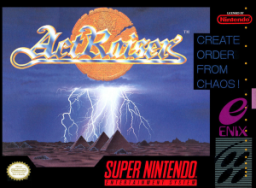
SNES - ActRaiser

Haiku-Review:

these beautiful towns
exist thanks to me - Earthquake!
my level increased

Additional Comments:

One particular genre I've always enjoyed is geographical sims centered around creating and maintaining a complex infrastructure, be it on a world scale, like the Civilization games, or on a city scale, like the Sim City games. I think it's just part of my long fascination with geography, cartography and overall world-building. More outlets to build worlds and drool over maps? Count me in. And so it goes for some time until one day, a friend of mine tells me about this game that combines world-building simulation and side-scrolling action. Hmm, I was a bit apprehensive about the idea as I tried to visualize the two mechanics meshing together rather clumsily, but it sounded intriguing nonetheless. So he let me borrow the game and I went home and popped it into my SNES. My jaw dropped. This was not just some simulation/action hybrid. This was a proud warrior standing tall above a rabble of meek and aspiring titles, all to fall short of ActRaiser's incredible ability to mystify and entrance the player with gameplay never before experienced.

That was me then. Thing is, unlike some of those early games that tricked me with a splendor of "magnificent" graphics or kitschy gimmicks like Donkey Kong Country, that's still me today. Ok, maybe I don't think ActRaiser is the king of kings in video games like I once did, but it still is an incredibly remarkable game that managed to blend two wholly opposing game styles into something that not only worked, but worked well. I will admit, however, that on the basest of levels, neither element is great in its own right (comparing apples to apples), but as a whole, it's more than functional and the various faults or annoyances can easily be overlooked.

Faults? For me, the game's biggest faults lay in the action sequences. While fun, they're a bit too straightforward. I can't quite put my finger on it, but they come across as simple - not in difficulty, but in presentation. Sure, everything that's dished out is brilliant - beautiful music, incredible graphics, and some nice sprite and object usage, but there's this lingering lifelessness that seems to overlap the platforming elements. It's the same sort of feeling I get when I play a Castlevania game - I fully understand why people like these games, but to me, they feel empty, cold or distant. There's something there, or rather, not there, that's keeping me from fully enjoying the experience. Additionally, the controls range from questionable to deplorable. Again, reminiscent of the lack of fluidity found in the Castlevania games, the controls are sluggish and at the worst of times, feel downright unresponsive. This feels most prominent when quickly alternating between left and right movement with the purpose of attacking opponents on either side. And the unresponsiveness really kicks in when attempting to jump and attack - in fact, as many times as I've played this game, I'm still a little uncertain as to how jump attacks are best meant to be executed. But don't think I'm out to find ways in which I can rake this game over the coals. Honestly, for this style of action platformer, the controls aren't that bad. The problem is every once in a while, you'll come across small pockets where you're forced to contend with the more noticeable issues, or should I say, the issues become more noticeable. For instance, I especially found this to be the case in Northwall's Act 2 in regard to some of its narrower vertical sections.

Still, the action sequences accomplish their required goals. They present a worthy case: they are well representative of their respective worlds, fare well in difficulty, and are finished off with a formidable boss - although there are a couple that leave much to be desired such as the pitiful Antlion. But what of the simulation sequences? Uh, hmm.... To be honest, there's very little to complain about, if anything. Other than getting stumped if you let the population stall out far too early, the simulation mode is well made and fun to boot. It's so cool to watch those tiny people face adversity and build a bustling town, despite those giant floating skulls of gold that would love nothing more than to devastate the entire land with their telekinetic seismic powers. Be it in the burning heat of Kasandora, the balmy jungles of Marahna or even the frigid cold of Northwall, these people will stop at nothing to see their lands settled and their communities prosper. Well, almost nothing. You do have to help transform the land, making it suitable for growth, whether it's washing away the sands of Kasandora with rain or melting away the frozen tundra of Northwall with the sun. And with that, my one and only gripe emerges - that little cherub constantly having to state the obvious and request confirmation. Yes, I want to send a ravaging earthquake through these lands. Yes, I want to wash away the desert sand, just like I wanted to the other twenty-three times - are you freaking kidding me!? Why is there no ability to skip over any of this. Sure, I can increase the speed - which is laughable in itself, because seriously, who's going to willingly set their conversation speed to 1? But yea, a speed increase just isn't going to cut it.

So there it is, a game when taken as a cohesive unit, is just simply incredible, but when you break it down to its core parts, there are some grievances that begin to surface. But again, my criticisms are not meant to be taken too seriously. Sure, the controls piss me off in the action sequences, but on the whole, I can easily forgive them, because the bigger picture is simply fascinating. It's easy to sweep the unwanted debris under the rug and just sort of forget about them. Annoying cherub, what? Exactly. Forget about it. The simulation is a total joy and is perfectly intermixed with some eventful action scenes. And add to that an incredible score; heck, not only is the debris out of sight, it's out of mind, by miles.

And speaking of score, I could list the entire soundtrack. It's that good. But I'll just list a few, namely Birth of the People, Northwall, and Peaceful World. Typically, I'm a bigger fan of Sega's chunkier sound engine, but ActRaiser is one of those games that really made the Super Nintendo's sound engine shine. Video game soundtracks had never sounded so awe inspiring, so full of depth and emotion. Somehow, I almost think that there's been very few that have ever managed it since.

Nano-Rant:

Let this be my apology and admission to fraud. I have failed the very core of my mission statement in regards to ActRaiser - to complete these games in full. I must admit that this I have not done. Yea, I beat Tanzra (a joke of a boss if you ask me, although the rest of Death Heim - especially the first two bosses - we're of a different color). But then.... The end - and nothing but. Wait a minute, something's not right.

That's right, the game never looped, thus never allowing me to access Professional Mode. I stared at that end screen for at least twenty minutes; nothing. I strolled over to GameFaqs, just in case I was mistaken on how to access the secondary arcade-style mode. I found nothing that I didn't already know. What pisses me off the most about this is that this is probably the fourth or fifth time I've beaten this game in my lifetime and I still have yet to experience Professional Mode. I know I'm not missing much outside of an upgraded difficulty curve and lack of simulation mode, and based on my side-scrolling control aversion, I should be happy. But it's the principle of the thing. Not so much for Beat All Games, but for the fact that I should have a fully functional game. Argghhhh!!

Rating: 4.5 loaves of bread out of 5

Saturday, July 23, 2011

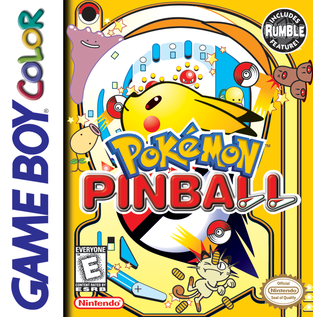
GBC - Pokémon Pinball

Haiku-Review:

with luck will I find
these wee damnable creatures -
thank god for Savers!

Additional Comments:

What a ridiculous game. No, seriously, mixing pocket monster collecting with the age old scraps of arcades and bars - ye olde pinball machine. But alas, pinball in console form has always been weak tea at best. Pinball will never be pinball without the fast-paced, bumper to bumper, ball-spinning action, and without the ability to really throw your weight into the side of the machine, well tilting just isn't the same - just an embarrassing attempt at imitation. Nevertheless, I've always found myself attracted to console pinball games. Yea, I know they suck compared to the real thing, but still, it's pinball. There's just something about popping that ball through all of the clever contraptions and raking in the thousands upon millions of points. Hell, I remember playing Pinball on the NES way back when as a little kid and loving it. Talk about a crappy pinball mock-up, that game was awful, but it was fun and I was entertained for hours trying to bag the high score.

So, while perusing through some games, I had the desire to play some retro console pinball games. While looking through my NES games, I began wondering what some of the more modern updates might be like, so I delved into some GBA games (ok, maybe modern isn't the right term here, but figuring I mostly play stuff from the 8-bit/16-bit era, yea the GameBoy Advance is modern). I dug up a game called Pokémon Pinball: Ruby & Sapphire. Eh, did I really want to play more Pokémon stuff? Well, it was pinball so why not? Honestly, the game surprised me. It was really enjoyable and the addition of a collection element burgeoned a whole new dimension of fun that I just wasn't expecting. But after a while I got to thinking that there had to be a predecessor to Ruby & Sapphire, otherwise why add the parenthetical? After some digging around, I found exactly what I was looking for.

After collecting about 150 Pokémon, I disparaged over stepping away to play what would obviously be an inferior game, due to the evident limitations between the GameBoy Color and the GameBoy Advance. But as I've stated before, I would like to try and knock out a series in sequential order if and when possible. And my immediate impressions were just that; I was suddenly playing a lackluster title. After fumbling around both the Red and Blue boards for a bit and managing to collect a couple dozen Pokémon, I just wasn't experiencing the same level of enjoyment that I was with Ruby & Sapphire. And after finding out what I had to do to get Mew, forget about it. I mean, come on. The Mewtwo bonus stage is ridiculous enough as it is, but I've got to do it twice? You've got to be kidding me! Jirachi wasn't even this much of  a chore to obtain in the follow-up. But then, figuring that Mew is absolutely impossible to get outside of cheats or glitches in R/B/Y, I guess I should be happy that Mew is this easy to obtain.

Eventually though, the game started to grow on me. Maybe it was just time, after all I've been slowly playing this over the past few months steadily building up my Pokémon database. And for a while, I just enjoyed it for what it was at its core - a pinball game. I spent hours trying to tally an impossibly high score, which isn't all that hard to do by the way once you open up the Mewtwo bonus stage but purposefully fail to complete it. I already had Mew, so why bother? But then the time came where I just wanted to get it over with and finish compiling my Pokédex, which is no easy feat. Some of those rares are damn near impossible to find, especially Pinsir, but more on that later.

Anyways, what started as a simple bump in the road turned out to be a decent game. True, I don't see this as a title that I can sell someone on - one part Pokémon, two parts lame-ass console-based pinball - bleaggh!! But it managed to accomplish exactly what a console pinball game should be, and that's all that counts for me. Besides, add in a bit of a collection mechanic to make it carry a bit more merit than just simply a high score and I'm totally game. It's a time-killer really, and other than offering top score bragging rights, isn't that what pinball is all about?

As far as music? Well as usual, and just like the music from any Pokémon game, I found it wholly detestable upon first listen, but over time it somehow grew on me until I eventually realize that all Pokémon games actually have great music. However, I'm still suspicious that it's all just a dirty trick. Since nearly all Pokémon games last for an ungodly amount of hours, you're forced to listen to these themes for days on end, so it's only natural that you'll grow to like it...or shoot yourself somewhere along the way, praying for tinnitus to set in so you don't have to listen to this cheeky bullshit anymore. Then again, I've spent an unprecedented amount of time on both Morrowind and Oblivion and I still hate the title tracks in those games. Anyways, try out the Blue Field: Catch 'em/Evolution Mode or Seel Bonus Stage for your listening pleasure.

(a not so Nano)-Rant:

Now then, let's talk about Pinsir and what a rat bastard that insectoid, clawed fucker is. The amount of time I spent trying to find this asshole was completely unwarranted. First of all, Mew, who in theory, should be the hardest Pokémon to come by, I managed to capture before I even had 50 total in the database. The thing about Mew is that you have a very specific set of guidelines that need to be followed - beat these games, beat these games again, travel to Indigo Plateau and then you have a 1 in XX chance that it'll appear (XX supposedly ranging anywhere from 16 to 32). Beyond this, I've seen various other arguments for objectives that must be completed in order to catch Mew - I certainly can't vouch for the validity of anything else, although I will admit that I had a Master Ball when I caught Mew. And you know what, Mew was the third Pokémon I had appear after completing the prerequisites.

So, what do we have to do to get Pinsir? Well, other than sit around in Celadon City (or Safari Zone?) - a whole lot of rinse and repeat in regards to Catch 'em Mode and having a hell of a lot of patience. Goddamn, you need some patience to coax this guy into appearing. At this point, I had 150/151 Pokémon (note that my Pokédex actually read 150/150 because I hadn't even seen Pinsir yet). I only had one stupid little creature left to bag and what did I have to rely on? The worst fucking RNG in gaming I've ever seen!!! There it is - it's all on the table now. Random Number Generators: they're great when they work but damn, do they just suck all the joy out of a game when they don't. I don't know how many hours I spent, but it was a good three or four days by the time I picked off my 150th Pokémon until I finally said "Fuck this!" and decided to GameShark it. I had a real bad feeling that was going to be how it all came to an end, and I tried my damnedest to avoid the inevitable. But after three or four days of fighting with a pissant RNG, I just couldn't take it anymore.

Code in hand, I caught Pinsir and quickly gave the game screen the bird. Yea, a big FU will show that game who's boss. I let the rest of my balls trickle into oblivion so I could end this thing (which took forever in itself since I had racked up so many Again's by this point), and sauntered on over to the Pokédex to bask in my 151/151 glory. Wait.... What!? 150/151!?!?!? I saw Pinsir but didn't catch him? What the hell, man!? Well, I guess the game got the last laugh after all...or did it?

As infuriated as I was over the whole matter to begin with, I wasn't going down with this bullshit. No way.... But I also had no desire to wrangle the RNG either, so I entered the code once more, caught Pinsir and proceeded to level him through Evo Mode. Take that, you fucking game - 151/151!! Yea, maybe I had to cheat to take it down, but with an RNG that broken and stubborn, I feel no remorse.

(Hmm, I think I managed more expletives in this one rant than I have in the whole blog to date. [/over-exaggeration])

Rating: 3 damnable RNG's out of 5

Sunday, June 26, 2011

SNES - The Legend of Zelda: A Link to the Past

Haiku-Review:

recall the adage -
keep in hand: Moon Pearls; don't turn
into a bunny

Additional Comments:

Having grown up with the NES, it is interesting to say that I managed to skip over the early games in the Zelda franchise without even so much as a wink of desire to play them. I know that's a pretty rare statement, but as I said in my post for the original Legend of Zelda, they just never really piqued my interest, especially since I was such a fan of games revolving around side-scrolling action. Then came along A Link to the Past, and my opinion of the Zelda games was completely uprooted. First it was the commercials. The "wow factor" tactics that the commercials utilized were incredibly effectual, and the stunning visuals just grabbed me. I still remember seeing those LTTP-style Hylian trees for the first time - their beauty just made you want to weep.

However, as amazing as those commercials were, I sadly did not come to own or play this game for a number of years. I guess their tactics were just an inch shy of perfection. Actually, with the arrival of Nintendo's shitbox - the Nintendo 64 - I jumped the fence without hesitation and became an avid consumer of Sony's new toy on the block, the PS1. With my dismay over the N64, I sort of lost touch with Nintendo's games, only bothering to play those favorites of my youth, such as Super Mario Bros. 3 or F-Zero. It wasn't until sometime in the late 90s, after discussing video games with a friend and mentioning how I had never played a Zelda game, he let me borrow A Link to the Past. As soon as I got home, I popped the game into my console and never looked back. Holy crap, I can't even begin to describe my initial impressions of the game - how incredible it was, how much fun it was...how...how much I couldn't believe this is what I was missing out on all those years. I spent every waking moment for the next three or four days trying to figure out puzzles, fighting Ganon's hordes of swarthy creatures and just generally exploring the beautiful Hylian countryside. My one and only trip up during that initial playthrough was when I had to dig up the ocarina. Somehow, I either missed or ignored the text explaining where I should dig, and ended up spending a few hours digging holes across all of Hyrule. Boy, did I feel like an idiot when I finally found it. Otherwise, discounting that single hitch, I managed the game rather easily on my first try and enjoyed every single minute of it; vaguely remembering the last time I had that much fun on an initial playthough of any game prior. And still to this day I'm not sure - SMB3 and Mega Man 3 are probably the only games I can genuinely think of in those regards.

Since that time, I've played and beaten LTTP numerous times and still love the game just as much. Interestingly, despite its "puzzle" mechanics, the puzzles never grow dull or tiresome. Although the solution is readily apparent, after years of play, I still enjoy figuring each and every puzzle out. Somehow, this game managed to make the puzzles timeless, which is definitely no easy feat. I can't explain how or why that is, but it certainly lends to its overall enthralling nature.

As far as the series is concerned, and out of those titles that I've actually put a concerted effort into playing, A Link to the Past is my second favorite of the series - just barely squeezed off the top step by Wind Waker. I know Wind Waker's a controversial pick, but for me, everything in that game is just spot on while managing to take a step back from the typical Zelda setting. But my thoughts on Wind Waker are for another time. However, despite being toppled by Wind Waker, the one element that I think LTTP managed to execute with absolute perfection is the item usage versus the overworld's puzzle architecture. True, most every game that followed LTTP handled overworld puzzles with near equal finesse, they never felt as genuine. To me, it seemed like the designers crafted LTTP's overworld with every single item in mind - knowing full well when items became available as well as when certain areas would/should become available. As such, they were able to create a complex overworld, as far as incorporating unique item puzzles, while still retaining an overall natural progression and feel throughout. Subsequent games, however, always felt like they had their overworlds designed first without any inclination as far as what might be included in the game outside of the common items seen throughout the franchise, like bombs or the hookshot. Then, once the game came into focus regarding the overall mechanics, the designers returned to the overworld and either modified small, congested areas in which they could place an item puzzle, or just outright tacked on an unnecessary element, thus discarding any sort of natural cohesion between landscape and puzzle.

And speaking of franchise comparisons, I know Ocarina of Time is often tagged as the most revolutionary of the Zelda games. Personally, beyond turning the series into a faux first person design, I disagree. Ok, there's more to it than that, and I admit that OoT did wonders for the series, but in my opinion, it was A Link to the Past that really set the stage for the fundamental mechanics of how a Zelda game should operate. Sure there's elements in LTTP that can trace their roots to the original Legend of Zelda, such as the boomerang or heart containers or the Master Sword etc., but I don't feel like they had any sort of inherent weight or meaning until LTTP came along. It's sort of hard to explain in words I guess, and I know my argument sounds hollow. Hmm, to put it another way: I sort of envision LoZ was created out of a mesh of random, undefined elements - sort of like a giant pile of "things," ie your dungeons, enemies, items, currency and so on. Basically, a lot of stuff that they eventually molded into a world, although rather haphazardly like a puzzle that doesn't quite fit together. Then came along Zelda II where it seems like they tried to remove that feeling of improvised creation, except they roughened up the edges around the rest of the game as a result - the puzzle pieces now fit, but for what purpose. With the third installment, suddenly everything just made sense. Everything had a clearly defined role and was well represented no matter where it appeared in the game. This is the big breakthrough that I think defined the series - not the eventual 360° total world interaction that OoT eventually introduced. I know it sounds odd to call that an innovation, or as I think of it, the innovation, but to me, this is the game that laid the proper groundwork for everything that was to follow - not the original LoZ and not OoT. Oh, and before anyone bothers bringing it up, no, my opinions of OoT are NOT influenced by my obvious hatred of the N64. Ocarina of Time is a fantastic game - it's the system that's a total letdown. In fact, I first played OoT on the GameCube with the Legend of Zelda: Collector's Edition disc, so yea, the N64 never even had a chance to influence my impression of the game. Hell, I didn't even see the game until I bought the GameCube edition.

Anyways, enough quibbling over which is the best or which is the most revolutionary. It's all conjecture when you come down to the nitty gritty I suppose. But that doesn't stop me from stating my belief that A Link to the Past feels like a near perfect game, not just in the scope of the Zelda franchise or within the SNES library, but in the vast video gaming empire in general. From the ease and fluidity of the mechanics, to the beautifully drawn graphics, to the enchanting soundtrack and the intricate, yet solvable puzzle design, this game just nailed it.

And yea, as far as music, who wouldn't love the soundtrack? Whether it's the charming Kakariko Village, the ominous Cave, or the snooty Hyrule Castle, the music is finely crafted and an absolute joy to listen to. No matter the location, the soundtrack properly represents the involved emotion or intended atmosphere.

Nano...what?:

Chris Houlihan room what?

Rating: 5 bunnies out of 5

Wednesday, June 8, 2011

TG16 - Blazing Lazers


Haiku-Review:

accepting lasers
as an admirable weapon
is it possible?

Additional Comments:

Wait, so there's actually an STG that has a decent laser? Incredible, but it's true!

What's funny is that a while back Sven and I were joking about how in most platformers or STG's, lasers, though cool by admission, are just completely useless weapons. True, their power is typically unmatched by any other weapon, but their speed, range, or rate of fire is just atrocious. Our conversation stemmed from an opinionated afterthought regarding Contra III by another friend of mine who believed that the laser was by far the best weapon in the game. Well, for me, the laser is the one weapon in that game that I will deliberately go out of my way to avoid, as if it were the plague. There is nothing that will bring that game to a sudden, grinding halt like attaining the dreaded laser - might as well just jump off a cliff and start the game over. Now, maybe I'm being a little harsh by grossly stereotyping the mass assembly of light-emitted weaponry, but let's face it, there's a definite commonality going on here - a slow-firing burst of absolute power - and for fast paced games, it's a guaranteed failure. I don't know, is the trade-off for power really warranted? As someone who will always choose speed or maneuverability over brute strength; that's a big emphatic no. Basically, what we're dealing with here is the Bowser or DK of the shoot 'em up world.

So what's all this about a decent laser if you're so quick to slander the thing? Well, I have to admit, not all lasers are created equal. Somewhere out there is a game that managed to turn the laser into an absolute badass of a weapon, and that game's name is Blazing Lazers. Heck, it's in their name! This game rewrote the book on laser mechanics in an STG. Not only is it an amazing weapon, it's quite possibly the best weapon! (Or damn near close - I have to admit, I still prefer the spread shot, which I'll explain my reasons later on.) So how can this possibly be? STG's, especially space shooters, typically contain the same set of weaponry, so even if you've only ever played one - like an R-Type or Gradius, you're still able to ascertain what kind of weapons will be available: a basic single shot gun and/or rapid succession variety, some form of spread shot, a shield, an assist, and possibly some sort of homing missile. Did I forget anything? Oh yea, a laser - and don't forget the disgust. Ugh....

With most shooters, I will usually grab the spread shot or homing missile and refuse to budge an inch regarding alternate choices. However, with Blazing Lazers, once I understood the weapon and upgrade system, I found the laser to be the prime choice since it too has somewhat of a spread effect. Sure enough, the rate of fire was down compared to the other weapons, but the way the lasers snaked across the screen, the slow ROF was barely noticeable, especially when paired up with a couple of assists. And who doesn't like assists? Myself, I try to use them as much as possible, that is until I realized the benefit of the firepower enhancement. Holy shit! Coupled with the laser and you've got yourself one badass mother. Firepower will turn the laser into a homing snake of evisceration that contains at least twice the firepower of any other weapon in the game. However, it does come with it's limitations. Unfortunately, firepower will return your laser to a single beam; therefore removing the illusion of a decent rate of fire. Back to the drawing board. Or is it?

My personal opinion, or at least what I found worked the best: the firepower enhanced laser works best for the first half of the game while a firepowered enhanced spread shot worked best for the second half, especially the last two stages. Seriously, I wouldn't recommend using anything but the spread shot for the last two stages, which I didn't realize until my playthrough on Hard mode. And despite Hard being far more difficult than Normal, the last two stages were a cakewalk as I blazed through them with the spread shot. Actually, on my first playthrough which was on Normal, Area 8 just frustrated and confused me to no end. There are sooo many bubbles! And they are everywhere!! During my Hard playthrough, I eventually found that you can pretty much ride the right edge the entire time and avoid everything - well, almost the entire time, and besides, the later difficulties chose to prove me wrong. But as far as Area 9 is concerned, sit at the top of the screen with a full power spread shot and you're golden - no matter the difficulty setting.

Ok, so Areas 8 and 9 turned out to be easy once I figured them out. Areas 3, 5 and 7 on the other hand - goddamn! Those levels are brutal!! Now, a sort of self-imposed challenge I've always tried to abide by in STG's is to complete the game without using bombs. Of course, it never works, and this game is no different. In these three stages, I found myself spamming bombs like there was no tomorrow. Seriously, without the aid of bombs, I don't know how or if you can even fight your way through them. Fortunately, Areas 4 and 6 were well deserved breathers where I could stock any lost weapons or bombs. In fact, I completely strategized my latter playthroughs around this knowledge - all my war efforts being geared towards Areas 3, 5 and 7. And I knew that once I completed Area 7, the rest of the game was gravy.

As far as music, it's usually hit or miss when it comes to STG's. For me, Blazing Lazers came through and had a fairly good repertoire of music. Some of my favorites were Area 5, Area 6 and Area 8 (heh, Area 8's  music just added to the general kookiness that is Area 8). And hey, the Ending Theme's not too bad either.

And finally, as a TurboGrafx-16 game, what can I say? The game is fantastic. Not only, that, but the graphics were amazing. I know I keep promoting the system in a more than favorable light, but the system just keeps astounding me, even with its mediocre titles like Legendary Axe. I'm curious to see how Blazing Lazers compares to its Japanese counterpart, Gunhed, though from what I understand, there's really no difference at all. Either way, Hudson managed to make a brilliant game.

Nano-Rant:

There is something that really bothers me about this game though. The lack of difficulty modes. Seriously, what kind of STG decides to forgo difficulty modes? But wait, didn't you mention various difficulty modes in your above comments? Ok, you got me.

Let me explain. After my first playthrough, I was sort of left questioning as too whether or not I ran the full gambit of the game. I found it curious that there was no options screen upon startup, but figured it was one of those situations where a new difficulty will open up after you beat the current mode. Nope. Well, I'll be damned. But then I find out you can access a hidden menu by mashing the I and II buttons repeatedly while holding Mode (or whatever NEC calls the Select button - wait, is it actually called Select? I forget) where you can set the difficulty between Normal and Hard. But wait, there's more. Inside the secret menu, you can  mash the same set of buttons while highlighting one of the aforementioned modes to bring up another, yet harder, mode - but you've got to do so for both modes if you want both of the additional "bonus" modes.

What the hell? Why is the difficulty menu such a pain in the ass to find? I can understand if you had to mash a bunch of buttons on the opening screens to find a debug menu or access some sort of cheat, but to make the game harder? Maybe I'm missing something. But then, what I really want to know: why can't you just press Run to exit the difficulty menu? Why do I need to press a combination of buttons!? Sure, it's only two, but come on, this is totally unnecessary. After finding out how to access the menu, I spent five minutes mashing buttons just trying to get out. Arrghhh!!!!!

Rating: 4.5 floating brains out of 5

Tuesday, May 31, 2011

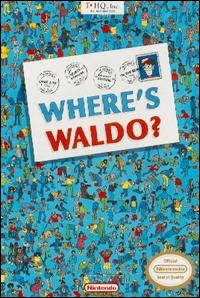
NES - Where's Waldo?

Haiku-Review:

stocking cap, glasses -
never ending walkabout
so, where is he now?

Additional Comments:

Well, after playing a string of solid games, I was bound to suffer some sort of abomination of the gaming world. I have to say, I've played some atrocious games over the years, but this just takes the cake, so much so that I would have to imagine that the developers are outright embarrassed over this horrible, horrible mess. And who are those developers? You've got to be kidding me - Bethesda!? For shame....

The real issue with this game is that the developers/producers should have known better. Sure, the gameplay aspect doesn't need to be fancy - simply find Waldo, point, then click - and this game does that. The problem is the artwork. Let's think back to the books and what made them so fascinating. The pictures were huge, full color drawings that managed to cram so much eye candy into small, pocketed areas while retaining an incredibly high level of detail. There was no mistaking anything, despite the pages being littered with hundreds of people, objects, gags and what have you. Even Waldo, no matter how well hidden, was still easily discernible from his surroundings. But take that idea and transfer it into a video game that can only use so many unique tiles and a maximum of what, eight colors? Forget about it. So to make up for the limitations, there's basically five or six unique, "shapely" figures while the rest of the people are just sloppily drawn stick figures. And then they're all jumbled together so haphazardly around the landscape that the whole screen looks like the remnants of a microwavable dinner explosion.

Furthermore, and this is what really got me, Waldo is not the easiest thing to find. Ok, he is once you know what you're looking for - which I admit, sounds a little strange if you happen to be thinking to yourself, I know what Waldo looks like. Oh, but you don't. Taking a look at the books again, we pretty much know there are three telltale signs to spot Waldo (five if you include blue jeans and brown shoes): his goofy striped bobble cap, those round, nerdy glasses and a red and white striped shirt. Obviously, the shirt is the most effective clue to finding Waldo with its red and white stripes. Fair enough, let's hunt down that red and white striped shirt - I'd have to imagine (or hope) my constant reiteration and conspicuous use of italics has not gone unnoticed here. Why? Because I found Waldo wearing a green and brown striped shirt in one of the stages!! What the fuck!?

*calms down*

Alright, so I played through Practice, where you're given the luxury of no timer, and fumbled my way through its two stages (seriously, I do not count the Cave as a stage, but I'll talk more about that later), trying to memorize what our stupid adventurer looks like so I can easily spot him when time becomes a factor in the latter modes. Of course, due to the color and size limitations of each pixelated character, the glasses were noticeably absent, so I had to rely solely on Waldo's striped attire and unshapely head-covering. Moving on to Easy, I located the red and white striped globetrotter in timely fashion, although various other discouraging gameplay faults hampered any sense of fun. And then we come to Medium - Train Station down, where the hell is he in the Forest stage? I spent the remainder of my time, some ten times over before I realized that the developers decided to take some liberties with the game regarding the harder modes and decided to swap Waldo's colors out. Why!? Why the fuck did they do this!? To make the game harder - bullshit!! That's nothing more than a blatant dick move. Seriously, what's the chance that someone, who has long had it ingrained in their head that Waldo wears a RED and WHITE striped shirt no matter the situation, might think: You know what? I predict Waldo has finally transcended fashion and may likely wear some butt-ugly green and brown striped shirts (or green and white shirts or whatever other random color schemes showed up in some of the latter stages).

Out of curiosity, I tried to track down an original manual to the game. Surely, there must be some sort of forewarning that the game has decided to go against everything we've ever known about Waldo. So, I found a pdf of a scanned manual, and thankfully, on page 6, the following can be found:
"In the medium and hard skill levels, Waldo always wears his characteristic striped sweater, hat and pants, but may try to fool you by changing his colors, making it extremely difficult to catch him."
Um, props that the company was considerate enough to clue us in on this, but for those of us without a manual, I guess it's just tough shit.  What's wrong with just sticking to the other implementations of difficulty: less time, larger stage area and smaller scope? At least none of that contradicts the Waldo namesake as we know it. Honestly, if it wasn't for Waldo sporting a red and white shirt throughout Easy, I would swear that it's  nothing more than a cheap excuse to mask an inherent palette limitation. Either way, it's unjustified, and in my opinion, is a prime example of why this game is utter crap.

Moving on, let's talk about the timer. On a primordial level, I find the mechanic useless; used only to introduce a false sense of difficulty. However, I understand its function within a puzzle-based game - Pipe Dream for example - as it causes the player to remain on their toes. The thing I find odd about this game though is that the timer is constantly ticking from the moment you hit start. Normally, I don't think it'd be much of a problem, but the developers decided to include an non-interactive overworld that takes forever to play out its automated moves. You easily lose 10-20 seconds on the overworld alone between each stage. So that 10 minutes you're awarded to complete Easy, after all the overworld shenanigans are said and done, you really only have about 8 minutes to complete the game. Again, why? Who were these braindead morons left in charge to make such asinine decisions regarding this game's production?  The stupidity present in this game just astounds me.

So, we have an untrustworthy adventurer who likes to change his clothing on the fly, a superfluous overworld that refuses to freeze the timer like it should and wears out its welcome almost immediately, incredibly juvenile artwork - yea, I know it's the NES, but seriously, that's no excuse - what else? Let's see: a stage that's a slot machine. That's right, a slot machine. All you have to do is get three Waldo's in a row and you win the stage. *facepalm*

And the music? Well, let me just say that I'm not even going to bother looking for links. It's annoying...let's just leave it at that.

So is that it? Eh, not quite. It seems I've forgotten to embellish my grievances of the Cave.

Nano-Rant Mega-Rant (as if everything before this wasn't a rant already):

How to put this delicately: What the fuck kind of stage is this!?

You're presented with a pitch black room - a cave. Every now and then Waldo will quickly dart across a small fraction of the screen, his image seen for roughly a tenth of a second. The trick is to click on him and then walk him over to the exit. The only saving grace is that an incorrect click will not deplete your time like it will on the other stages. With that knowledge in hand, it's obvious that playing the stage in the ideal fashion is pointless. It's better to just randomly click all over the place until you finally gain control of Waldo. What a fucking intuitive stage. I feel sorry for anyone who actually paid money for this game back in the day. Oh, wait, I'm not done. I nearly forgot about the hourglass icon. So it plays like this: once you gain control of Waldo, two icons appear on screen. One icon is a blank, white square - this is the exit. The other is a white square with the picture of an hourglass. Instinctively, I figured this would give me more time - something that seems to be at a serious premium in this game. Nope, it immediately subtracted an entire minute from my time. What the hell kind of bullshit is that!? The one interactive object in the game hinders my gameplay experience? Again, this is an instance where the game manual would come in handy, after all, there it is on page 8:
"If you wish to gamble, take Waldo to the hourglass first. Press the A Button here and you'll either win approximately an extra minute of time, or lose one."
Normally, I have no qualms about not being privy to certain information because I don't have the manual, but this is yet another instance where I have to question the intuitiveness behind the game's included features. Manual or not, I should be able to conclude what the icon will do based purely on prior gaming experiences that also use an hourglass icon. And having played countless games where an hourglass symbolizes some sort of benefit in regards to time, be it additional time or temporarily freezing time, it's natural to think this mechanic would remain constant. Therefore, it's instinctual - if you see an hourglass, you grab it. Why change a mechanic of a well known and trusted symbol? Again, like Waldo's alternately colored shirts, it's nothing but a dick move.

But hold on. According to the manual, it can add or subtract time. Ok, I suppose I can live with that, except that my first hourglass experience, like I said, killed off a precious minute's worth of time. Well, the hell with that hourglass. Why would I ever touch it again? Without prior knowledge of an either/or situation, I wouldn't. I guess I just got the short end of the stick by getting the worse of two outcomes on my first try.

Admittedly, half of my complaints could be attributed to a lack of information regarding the game, but I'd say it falls in the lap of negligence, on behalf of the developer, regarding established principles regarding both the Waldo franchise and gaming practices in general. Basically, Bethesda took a brilliant late 80s/early 90s phenomenon and seriously just fucked it up.

Rating: 0.5 non-animated moon jumps out of 5 (or better yet, is 0 out of 5 allowed?)

Sunday, May 29, 2011

SFC - Do-Re-Mi Fantasy: Milon no DokiDoki Daibouken

Haiku-Review:

the music ensues:
Baron's son saves Fantasia
from evil Amon

Additional Comments:

What's this? A sequel to Milon's Secret Castle? Hot dog!!

I can't express enough how floored I was when I first found out about this game several years back. Milon's Secret Castle, long one of my favorite games on the original NES, despite a thick web of slander from the general gaming populace, always entreated me to a bittersweet experience - it's great, but I always wanted more. But alas, the one-off title from Hudson was all we ever got. Sigh. Well, that's not entirely true. Little did we know that game companies were pumping out incredible titles localized only for the Japanese market. Sure, as kids, we had an inkling that was the case; which was confirmed with the release of Super Mario All-Stars where we were first introduced to an alternate Super Mario Bros. 2 known as "The Lost Levels" - wow, a version that was an actual direct sequel to the first SMB as opposed to the bizarre and rather uncharacteristic DokiDoki Panic graphic swap that we got. So we knew that some Japanese-only games existed, but we didn't really know just how many of them there were. On top of that, the games were pretty much impossible to come by - importation and beaucoup dollars being the only option. I'll always remember hearing tales of that "one kid" in school who would spend exuberant amounts of money to import a Famicon along with a few games. Unfortunately, it seemed like that "one kid" always imported Japanese localizations of games we already had access too, only because the Japanese localization typically came out a few months earlier. What a waste of money.

With the advent of emulation, practically every game, regardless of localization, is at your fingertips. And with a fairly prevalent emulation and ROM hacking community across the net, there seems to be some degree of translation available. Although, when I first gave the game a whirl a few years back, I didn't have my hands on an English translation, so I was more or less lost in the dark when it came to story and what exactly the items did. Being a platformer (where "jump" and "action" are the dominant controls), and the fact that some instructional animations are presented in a series of beautifully drawn cutscenes, the language barrier was pretty transparent as far as being able to enjoy the game for what it is. Not like Madou Monogatari - sheesh, I still don't know how to do anything in that game. Regardless, I managed to track down a worthwhile translation for my latest playthrough and I have to say that it was refreshing to actually understand the storyline and read the descriptions of each item. Although I understood the usable items on my first playthrough, I had no clue what any of the instruments did, and for me, that was the most welcomed text translation.

But enough talk of localization, emulation and translations - let's talk about the game. Do-Re-Mi Fantasy is easily one of my top three favorite platformers for the SNES/SFC. Although I probably initially went into this game with a biased mindset, thanks to Milon's Secret Castle, I was not disappointed. The gimmicks, though I wouldn't call anything innovative, were well executed and gave the game a very unique feel. Even the world themes, again, nothing innovative here; they just felt so contemporary. Oh, and something else I have to touch on regarding these Japanese games: the artwork is just gorgeous. It's not true for every Japanese-only game, but some of them - it makes it seem like a lot of the US games got stuck with the B-team artists.

Now, compared to Milon's Secret Castle, Do-Re-Mi Fantasy is so wildly different that, apart form the bubble shooter, if you didn't know it was a sequel, you would have never known. Whereas Milon's Secret Castle was more of a puzzle game (yea, I'm aware that most people think otherwise, but I also think that's why a lot of people mistakenly hate the game - they don't understand what kind of game they're playing. Naysayers can refer to my post about Milon's Secret Castle), Do-Re-Mi Fantasy is a rudimentary, point A-to-point B platformer. Outside of a few hidden bonus rooms, which included some cool little bonus games by the way, this game is completely devoid of any sort of puzzle mechanic. And that's not to say it's bad...or good, but a stark contrast to the original while retaining some of the defining features that made the first game so great, like an overarching theme steeped in music or Milon's trusty, yet oft criticized, bubble shooter. Additionally, the health bar has been swapped out for a much more engaging hit system that utilizes outfit upgrades.

For the most part, the levels are short and sweet. Each one focuses on a unique gimmick, often depicted on the overworld itself, giving each level a clearly defined individuality while encompassing the overall theme of the world. For instance, World 1 is a generic forest world, but there's a stage built around a log fume ride or a stage engulfed in strong winds. Sure, you can say that's true for any platformer, but there's something about this game where it never feels recycled for the sake of making additional stages like a Donkey Kong Country or even an early Super Mario Bros. game. I'm not going to lie, I love having countless stages, especially in the SMB series, but there comes a point where the stages grow stale or repetitive and eventually just start blending into each other - prime examples being the entirety of DKC or World 5 of SMB3 (which it shames me to say because of how much I love that game). Basically, this game plays more like a non-OW platformer - the type of platformers where all you get is a good, solid seven to eight levels of intense platforming genius and you're done. But somehow, Hudson took that concept and managed to spread it over some 40-50 levels and make it work.

Finally, I can't talk about this game without talking about the music. Not only is the music fantastic, but I love the use of atmospheric tracks as well, namely Church Bells Ring. Anyways, just to name a few (more musical) tracks, try out: Through the Woods, Dessert Paradise, or Staff Roll (wait a minute, is that an early precursor to Gentle People's Journey that I hear?). And speaking of Staff Rolls, is it just me, or do composers generally push their best work into the end credit themes?

Nano-Win (perhaps?):

So what's better than a sequel to Milon's Secret Castle? How about three additional sequels?

Ok, as far as I'm concerned, these sequels are nothing more than rumor. Supposedly, some (episodic?) sequels were released on the Nintendo Satellaview, but with nothing more than a few fragmented game lists and rather ambiguous bits of information scattered around the net, who knows what's really out there. I have "played" a game entitled BS Do-Re-Mi No. 2, but it was nothing more than adverts, articles and how-to-draw artwork - all in Japanese, mind you. Are there really three additional games? Maybe, maybe not. As long as the Satellaview is an unfortunate anomaly in the world of emulation, I say it's pretty much up to pure speculation at this point.

Rating: 5 children-eating snowmen out of 5

Wednesday, May 25, 2011

GEN - ToeJam & Earl

Haiku-Review:

sneak up on Santa
before he rockets away -
more presents for me!

Additional Comments:

Along with Sonic the Hedgehog, ToeJam & Earl is one of my earliest Genesis gaming memories. And where Sonic wowed me with its speed, ToeJam & Earl won me over with its innovative approach to two player co-op - not only allowing the two players to wander in separate directions via split screen, but also allowing the players to exist on differing levels if an unfortunate fall should occur, allowing continuous play without needlessly stalling the game or causing jumps through time and space to bring the two players back together - although, there is the Togetherness present. Despite the mechanic, which allowed for twice as much ground to be covered in the same amount of time, I remember whenever my friend and I played this game as kids that he was real adamant that we stuck together out of fear of death and eventual game over. For me, that always took the joy out of playing the game in two player mode. Instead of two intrepid alien explorers wandering across the floating mazes of Earth, it just felt like one unfortunate guinea pig to lure the evil Earthlings away from the other, more funky, present-grabbing money-grubber. It reminds me of "playing" Tails in Sonic the Hedgehog 2, because someone convinced you it is indeed a two player co-op game and that "don't worry, it'll be a lot of fun!" No, it's a one player game with someone along for the ride to act as the first player's early warning defense system. Lame.

Nevertheless, my belief is that this game is best played with two players. But that does not discredit the game's single player experience. Just as much fun can be had, especially with the game's ability to randomize level layouts, creating an infinite replayability factor. Sure, Fixed World presents a fun and challenging affair, and in my opinion is the preferred mode to legitimately "win" the game, but the real allure of the game is to be found in Random World. Of course, true randomization is pretty much impossible within the parameters of old generation games, but ToeJam & Earl manages the feat rather competently. Pulling the "safety net" out from under the player creates a whole new challenge with each playthrough. Other than understanding the fundamental proximity and attack patterns of each enemy sprite, there's really nothing to rely on as far as level memorization - i.e., ship locations, elevator locations etc. The ability to randomize each level furthers the exploration aspect of the game, especially when it comes to using the Icarus Wings, or to a lesser degree, the Rocket Skates or Super Hi-Tops.

Which brings me to my next point: presents. I've always loved the item usage in this game. In a way, the game reminds me of the Earthworm Jim series, although the Earthworm Jim games were developed some two years later. Like the Earthworm Jim games, ToeJam & Earl has that certain sense of madness and oddball humor throughout. If it's not the Earthlings themselves that radiate this bizarre aura - Earthlings like the Nerdherd, a roving stampede of geeks; or Chickens with Mortars, firing tomatoes with deadly accuracy - then it's the presents. A cornucopia of goofy gifts await ToeJam or Earl's needs. From the aforementioned Super Hi-Tops, to a jammin' Boombox; from a set of Rosebushes to the precarious Tomato Rain, presents offer up some of the strangest power-ups I've ever seen in a game. And although an annoyance, I enjoy the fact that both good and bad presents exist. Not everything is a benefit, as with the Tomato Rain or even worse, the Bummer - woe to those who unwrap a Bummer. Sure, it creates an unwarranted danger or even cheap death, although it can easily be avoided by just dropping the unwanted gifts, but it adds to the peculiar wackiness attributed to the game.

And if all that wasn't enough, throw in a soundtrack that sounds like a DJ Jazzy Jeff record or something Eric B. would piece together, tracks like Funkotronic Beat or Elevator Beats; add some bright, colorful backdrops during the level load screens, and this game easily takes top step as one of the zaniest games ever made. With the music and art direction, the game was spot on for the early 90s, but sadly, now it's nothing more than a quirky little period piece exploiting 90s hip-hop and embracing a clever exploration element that once seemed so rare in console games. Overall, it's a great game; one of my earliest and fondest memories of the Sega Genesis, and one of the coolest two player games I've ever played.

Nano-Rant:

Several of the Earthlings definitely have their annoyances: the Phantom Ice Cream Truck's speed, the Mole's pilfering hands or the Boogie Man's...well, the Boogie Man, but I've got to say, damn, I hate Tornadoes. It amazes me how every time, without fail, those things will dump me over the vast emptiness of space forcing me to drop down a level.

Rating: 4.5 Wahines out of 5

Monday, May 16, 2011

PC - VVVVVV

Haiku-Review:

such interference -
flip up, flip down, save the crew
from Yes Men and Lies

Additional Comments:

VVVVVV is simply put, fantastic. It's amazing to think that a game built around a solitary, yet simple mechanic can feel so refreshing the whole way through. In fact, I can't even remember the last time I had so much fun playing such a fundamentally basic game. Unlike most platformers, your controls are extremely limited to more or less three separate actions: moving left, moving right and flipping gravity. And that's it. But what amazes me is that on paper, and I've seen this as I've tried to explain the game to friends, it sounds a bit too simple, if not boring. However, it's far from it. It exudes layers upon layers of creativity around one simple function, and does so with gusto.

Unlike most modern games, VVVVVV embraces the retro scene; brilliantly skinned with a Commodore 64 flair and accompanied by an equally magnificent chiptune soundtrack that would make a SID chip proud. Tracks like Pushing Onwards or Positive Force just stamp their authority all over the VGM pantheon. Honestly, I could list every track in the game - not a single lull in the mix - but seriously, do yourself a favor and just buy the album. I think what makes this game stand out among the recent influx of "retro" games is that it not only looks or sounds the part, but can also play the part. I think where a lot of these new "retro" games fail is when they take advantage of today's technology regarding gameplay mechanics as opposed to remaining true to the strict limits imposed by ancient technology or rather the systems they're trying to emulate. I'm not saying that's bad, but it definitely amps up the cool factor to see a "retro" game adhere to the true meaning of retro. Of course, the fluidity of Captain Viridian's movements, along with other sprite animations, goes a bit above and beyond - a dead giveaway that we're in the 21st century when it comes to game presentation - but overall, it still maintains that certain something that mysteriously turns our present day computers into the clunky old dinosaurs of the past.

If I had to pinpoint a singular defining element that really makes this game shine, then it's got to be how well the developer is able to take an idea and run with it without it growing stale or enduring pointless repetitions. Sure, the flip element is repeated ad nauseum, but it doesn't come across as a chore since each screen presents you with an increasingly difficult or perplexing set of dangers that challenges your reflexes and/or wits. Add to that, additional gimmicks integrated throughout each stage, such as rebounding between "trampolines," auto-scrolling, or even level wrapping, and you have a fantastic challenge on your hands at every turn...er, flip.

Now, I've read that the game is well regarded for its difficulty, and although yes, when I first started out on my perilous quest to save my crew members and perhaps find a way to end the temporal distortion, I fumbled through a few areas, having to accept a large quantity of deaths - especially trying to collect the trinkets in Veni or Edge Games (although I will admit that I was trying to make Edge Games much harder than it was, attempting to abuse a boundary glitch before realizing what the actual solution was - boy, did I feel dumb). Also, the Gravitron still gives me grief - not to mention the Super Gravitron. But really, the game's not all that hard...well, as long as you're just playing Normal Mode or even Flip Mode (which I found even easier, but that's likely because I was use to the game by that point). The Time Trials and No Death Mode, however, is a whole other story.

Despite my claims to wanting to 100% everything, I've mentioned in the past that elements which are irrelevant to "beating" the game will likely go unbeaten. So is the case here. For VVVVVV, I decided that I will at least unlock everything as well as make a worthy attempt within each mode. Seriously, the Time Trials are just gut wrenching if you hope to achieve the V Rank. I managed S Rank in four of them, claiming A's in the other two - enough to unlock No Death Mode; enough to satisfy. Still, I suffered the Time Trials to at least try and achieve S Rank in all of them, and I'll likely continue to try and conquer the Time Trials altogether, but as far as Beat All Games is concerned, forget about it. I even gave No Death Mode the old college try and only made it through two stages at best. So yea, the game may not be tough, but the bonus material is downright relentless.  Oh, and did I mention the Super Gravitron? It seems I have.

But even the difficulty surrounding the bonus material can't stop me from calling this a perfect game. Honestly, I can't find a single fault. Anything that I might even consider berating, there's just no cause. As aggravating as No Death Mode is, it's not a question of annoyance, but of challenge, and I love that. I don't know how, but Terry Cavanagh has somehow found the perfect balance, or zen if you will, between fun and frustration. There hasn't been too many games where I've expressed such a level of elation that I've urged others to play them (Banjo-Kazooie is the only one that comes to mind at the moment), but this is definitely one of them. Hell, I'll even give you the link: VVVVVV.

Nano-Win:

I can't possibly go without mentioning how adorable the sound effect is when any of the characters are stricken with grief. And then to see them smile again when they get that feeling that all will be just fine. It gets me every time.

Rating: A solid 5 Murdering Twinmakers out of 5

Friday, May 13, 2011

NES - StarTropics

Haiku-Review:

yo-yo weaponry
to face denizens of space
in South Pacific

Additional Comments:

StarTropics has long been one of my favorite NES titles, despite it being nothing more than a mediocre Legend of Zelda clone. But there's something magical about this game that sets it apart from Legend of Zelda, or any other overhead action-adventure title from the 8-bit era. For me, it's the setting. True, the depth and scope may not be the same as say LoZ, but with such a unique setting - a lone archipelago in the South Pacific - it gives the game an unexpected breath of fresh air. Certainly, the game's spiral into space opera-esque science fiction could easily be compared to LoZ's high fantasy plot devices, but the fact that StarTropics' sci-fi nature just sort of creeps up on you slowly, and almost unpredictably, helps to differentiate the almost necessary evil of video game intrusion regarding wild imagination; which in turn helps to present the game as nothing more than a happy romp through the islands over the course of the first few chapters. To some, that may sound boring, but to me, I find it a daring and creative departure from the typical "fantasy" of most games. And by having that "fantasy" element introduced through a slowly evolving story, it caters a more plausible, natural progression, ideally softening the blow by the time we're dealing with it full force.

I am a bit up in the air regarding the overworld mechanic used in this game. Unlike typical overhead action-adventure games, the overworld is free of danger, which allows for an easier sense of exploration, however I've always felt they could have made exploration a bit more worthwhile. As it is, the exploration aspect is very linear, much like Zelda II, or incredibly useless offering nothing to further enhance the gaming experience. Sadly, the only optional material with any inherent worth is the gathering of hearts to further fill your life bar. But come the end of the game, it doesn't matter how many hearts you bothered to collect, because the second Cube raises your life bar to maximum hearts anyways. Additionally, a danger-free overworld sort of makes the whole concept rather arbitrary. It's only function is to allow for travel between chapters, meet NPC's (the vast majority of whom have nothing substantial to say) and seek out dungeon entrances. If the developers had at least worked to create more exploratory devices, it wouldn't matter. But as it stands, it's a lot of needless walking around - especially since most of the islands are designed in such a way that the paths are directly forcing you from point A to point B.

The dungeons, on the other hand, are fantastic. Basically, they come across as further developed LoZ dungeons - allowing for larger rooms through the use of scrolling and trickier obstacles thanks to Mike's ability to jump. Yet despite the obvious upgrades, the dungeons stay true to the overall design methods first introduced in LoZ: room by room progression with a number of rooms requiring the completion of a simple task or puzzle in order to move on, either by defeating all of that room's evil denizens or by finding a secret switch. And in latter dungeons, the exit might be hidden beyond a cleverly disguised false wall - ugh, I hated that concept in LoZ. At least they use a small telltale sign in this game. And finally, you have your lair bosses which are equally reminiscent of those found in LoZ - in fact, most of the enemies are, especially the Octot which could definitely be confused as Octorok's lost twin, sans the ability to fire projectiles.

Of course it could be argued that the dungeons aren't all that impressive considering LoZ came out in '87 and StarTropics in '90. Three years, and Nintendo's overall approach to dungeon architecture is relatively the same. But seriously, is that a bad thing? Personally, if it ain't broken, don't fix it - which seems to be exactly the mentality taken going into the game and I laud the developers for taking that approach if such was the case. However, I believe if you're going to stick to your guns regarding how a certain mechanic works, you shouln't necessarily take away from it, as is the case with item handling. Yes, there are a few variant weapons outside of the the yo-yo (which is eventually replaced with a laser gun known as the Super Nova), such as a bat, reflecting mirror, or blaster, but for the most part, I found them to be fairly unnecessary outside of a few situations in which they are required (fighting Dimhags for example).

Nevertheless, despite my grumbles, this is still one of my all-time favorite NES games. And yes, although it recycles old ideas, it manages to do so with such an intriguing twist that it ends up creating its very own distinctive atmosphere. Add to that some delightfully bouncy themes such as the Island Theme or the Cave Theme and you've got yourself a fun little adventure throughout the South Pacific. Needless to say, I enjoyed my latest playthrough just as much as I enjoyed my initial run some ten odd years ago.

PS: I can't possibly post this update without including the dreamy Treasure Room Theme.

Nano-Rant:

Ok, I do have one major complaint about this game: the controls inside the dungeon, or more precisely, the directional controls. I hate them - flat out hate them!! They are so goddamn stiff and lag-ridden. The hampered reaction time really creates some unnatural difficulty in a few choice spots in the latter dungeons. The jump and attack buttons however, are fine. I don't know what it is, but somehow, the d-pad falls disastrously short - even compared to the overworld's controls. How can the overworld's be so fluid, yet the dungeon's completely miss the mark? It's literally a night and day comparison between the two areas.

Additional Bonus Rant:

And seriously, how can game developers be so goddamn shortsighted to believe that a piece of paper, that you have to dip in water no less, expect to keep a proper life expectancy to continually coexist with the game pak ever and anon!? What the hell, man!?

Rating: 4.5 747's out of 5