Monday, May 12, 2014

DC - Shenmue

Haiku-Review:

'tis best to follow
a game about warehousing
with more warehousing

Additional Comments:

To speak of Shenmue, I feel I must begin with a wholly controversial; borderline, er...perhaps over the line blasphemous remark. Simply put, I am flabbergasted beyond words that this game is held in such high accord among the gaming community. Maybe dumbstruck's a better word, because that's exactly how I felt the entire playthrough - stricken dumb by the idea that Shenmue dares call itself a game.

Well, to continue the tale of 2014, Shenmue is yet another game that's been collecting dust on my backlog of unfinished games, although extraneous circumstances also came into play here. I've been meaning to perform a battery swap on my Dreamcast ever since I bought it a couple years back and just failed to do so out of laziness. Of course, blaming "technical" issues is farcical at best as the system is still playable. But my obsessive compulsive behavior got the best of me every time I powered the system on and had to re-enter the date and time, eventually growing tiresome of the task. Luckily, Shenmue's such a pile that my apathetic predisposition solved the apparent problem at hand. Only drawback is that all my other Dreamcast games found themselves tucked away in the recesses of my collection until the required repairs were made.

I finally got around to making the appropriate repair and as such decided to wipe another game from the unfinished slate. Dropped in the disc and turned the game on. Crap! I haven't the foggiest idea what's going on in this game anymore; never mind how to even do anything. At this point, I felt the best course of action was to simply start over again. I had no clue where I left off, what I was supposed to be doing, or why I should care and given how much emphasis is placed on conversation in this game, attempting to continue after a two year lapse was not only hopeless, but stupid.

Ok then! Shenmue! From the beginning! Let's see what it's all about. And might I add, I'm attempting to go into this playthrough with more of an open mind, hoping to put aside my previous bellyaching. Oh my god, it's all coming back to me. I suddenly remember why I condemned this game and lambasted it with a snide meme a couple years back in one of my anniversary posts. But before I fall headfirst into a laundry list of complaints, I want to try and remark on those few redeeming values found within.

The overhead music heard within Dobuita's Tomato Convenience Store is the catchiest piece of elevator music I've ever heard and I'd purposefully put aside the troubles of tunnel-visioned vengeance just for a quick earful of its delights.

And...and...that's it. Seriously, that's it! Ok, maybe there's a few more positives than that, but I'll be damned if I know what they are. I'm really wracking my head trying to think of commendable qualities and every time I think I have one, it's riddled with failure. Even Tomato's BGM is a peculiarity given how the rest of the music is sappy drivel or humdrum atmospherics. No. Both "sappy" and "atmospherics" are too descriptive and enlightening to describe the unemotional, drawn out boredom that is the soundtrack of Shenmue. I'd be happy if it was at least cliché, but it's not even that. It's certainly not painful or distracting to listen to, but it adds absolutely nothing to an already boring game. For collection purposes, I bought as many cassettes as I could, but couldn't bring myself to listen to any of them. I tried, but it's all just so...awful. So awful. What a waste of yen and time. But honestly, the music is the least of my grievances.

Where should I start? The controls? The plot? The voice acting? Or any of the various elements that come together hoping to mesh into a cohesive game and achieve realism as it has never been seen before? I need to stop right there. I'll admit that for the time, considering when the game came out, Shenmue managed some pretty impressive innovations in game design and presentation. I think a lot of what's going on in the game can easily be taken for granted when compared to games today. Shenmue managed a certain beauty and depth that was all but absent in most games before its time, but it also botched it all up with primitive game play elements that's barely a step above an interactive storybook.

I suppose I'll get the easy stuff out of the way first. Controls. I can't really blame the game for the controls as the Dreamcast's controller is complete bollocks, but I think they could have done a better job using the tools at hand. Movement should have been applied to the joystick. I can't understand why the camera got precedence over movement when it came to control application, especially since the camera is so useless outside of a few first person explorations, and even then it's shitty at best because of the camera lock. Since the d-pad and joystick both occupy the left side of the controller, you will pretty much never use both at the same time. They could have easily applied both to the joystick having the camera only function while zoomed into first person view. One of the main reasons why I would have liked to seen movement set to the joystick is to allow for better overall turning and to get rid of that awful down equals quick turn garbage. Also, the d-pad makes the movement feel spongy. Heck, all of the controls feel rather spongy. If it wasn't for the fact that my controller is brand new, I'd put it down to the controller itself, but the controls in this game are just so unresponsive except when it comes to the fighting.

Actually, the fighting mechanic turned out to be one of the better elements in the game. Unfortunately, I'm not a big fan of fighting games, mostly because I despise thumb-twisting button combos used to perform enough moves to fill an almanac. To me, these types of games just end up being button mashers. Same proved true here. In the beginning, I tried to adhere to various button combos. Since the controls managed to be spot on for this part of the game, I was able to perform the required protocol for each move-set quite handily. However, as the game wore on and various "teachers" continued to teach me additional moves, I became disinterested in move-set memorization. This resulted in regressing back to classic button mashing. Just throw a bunch of kicks and move on. I don't think I even used the move Master Chen offers before the final battle as I had a hard enough time fumbling with it during its mastering. Kick and wait, and then kick again - that's all you need. Mad Angels defeated.

Before I move on, since I'll find myself circling back around to the fighting mechanic, I have to wonder about the QTE segments. For a game that's attempting realism and fully immersive play, the QTE segments are like that of an asshole suddenly running up and throwing mud in your eye. They're nothing but a dickish memorization mechanic quickly ruining any sense of immersion. Yu managed to create a living, breathing community within Shenmue, and as I said, given the time, is a spectacular achievement. As such, it's one of the earliest games where I think the player can make a genuine bond with Ryo or any other element within the game because there's a certain warmth of environment. Er, I use the term "warmth" loosely here, as the game is anything but warm, but more on that later. But then you have these QTE segments that suddenly reminds us how cold and mechanical a video game really is. Perhaps if choice on the player's part came into play, these scenes would actually add something to the game. Instead, they're practices in memorization and nothing more. Other than two scenes, if you fail you have to redo the whole scene. Why? Why aren't these just cutscenes if that's the case!? There's no reason for any of the QTE segments if there's no chance for optional outcomes. If I wanted to memorize a sequence of buttons presses, I'd play any number of present day music games, or hell, Battletoads.

Or...or, here's a brilliant idea. Since a majority of the QTE segments are based on scripted fighting, why couldn't they have taken advantage of the already implemented fighting engine and let the player determine their own fate? The fighting engine sees so little use as it is. Outside of practice or sparring with Fukuhara, fighting is a rarity. I spent more time driving a fucking forklift than I did fighting! Yea, that's what kids want in their games: forklift simulation. But, we'll offer them a fighting mechanic as a tease by minimizing the amount of playable fighting by storyboarding most of the fighting into constrictive "interactive" cutscenes that rely on quick reflexes and memorization. What the fuck!?

Ah yes, the forklifts. Ok, it's not so much that I loathe Shenmue's sudden urge to become a dockside simulator - although I do - but more how the game seems to give the player a diminishing sense of freedom by the time you reach the third disc. Ryo's day job as a forklift operator already eats up so much of your day. You'd think once the whistle blows full control of Ryo's will would fall back into the player's hand. Well, technically it does, but only if you have the same desires to stay within the confines of Yokosuka Harbor that the game demands. I understand that at this point of the game, everything needed to progress the story is in the harbor, but I'm not a fan of the sudden hand-holding approach the game takes to keep you there. I thought the game was built around this idea of world freedom. If I want to leave the harbor before 9:00pm, or whatever time Shenmue finally concedes to Ryo's wishes to return to the comforts of home, then let me.

Then there's the forced sleeping. Itself, it's not really an issue, but by the time you reach the third disc and take on a job , the two compulsory elements combined strip the player of all real freedoms. Hey, I guess it is like real life after all. Wait. Why would I want to play a game like real life? Games are supposed to be entertainment and a way to escape real life. You can't even make decent use of the money you earn because that two hour window between being allowed to leave Yokosuka Harbor and having to return home for a night's sleep is just barely enough to take advantage of anything on offer in Dobuita, which is limited itself since half the town is shut down by that point. Suppose I can pick up a few cassettes at Tomato and catch a quick listen of its captivating Siren song.

What was I initially jabbering on about? Ah yes, the forklifts - another "If I" moment. If I wanted to play a game that's all about moving boxes, I'll go back to playing Shove It!, and believe me, that game was a hell of a lot more fun.

Moving on to the story. First, I want to hit up the voice acting. Granted the voice acting obviously doesn't fit the characterization, but that's not my issue. My issue is that they could have done a better job. A few particular characters have decent voices: Nozomi and Fukuhara come to mind, as do some of the various elderlies, notably Ine. Their voices seem to fit their personas. Then there's others where the voices are either too strongly Amercanized or even have some odd accent attached. I swore I heard someone with an ever so slight Aussie inflection. What? And then there's Ryo. It wasn't so much his voice but his way of speaking. Why is his speaking so slow and carefully articulated. It's so unnatural compared to everyone else, or anyone else. He sounds akin to a first grader who can only use monosyllabic words. Combined with his constant hounding: "On that day, did you see a black car? What can you tell me about that black car? Do you know anyone who may know about Chinese people? Do you know where I can find any sailors? Do you know about the Mad Angels? Do you know where I can get a job? Do you know of any travel agencies?..."

Hold on. That last question I literally asked someone directly in front of the door to the travel agency. Is Ryo that fucking dense? Does he have any clue of what's going on in the world or is he so preoccupied with revenge that he's got blinders on when it comes to everything else. Given how obtuse he is when it comes to Nozomi, should it really be of any surprise? Even Eri's constant nagging, hoping to snap him out of his fog is no use - although her frustration over the matter was of an even more discerning nature. Actually, when it came to the subplot between Ryo and Nozomi, this was another part of the game where I wish the player had more input allowing for multiple outcomes. Otherwise, just leave me to my clichéd ploy of vengeance and let me get on with my life.

Then again, the way Ryo and Nozomi's subplot is handled speaks volumes in regards to the rest of the game, much like the QTE segments. The player serves no real purpose in this game. Yu Suzuki should have realized what he was really trying to accomplish here is a movie. Instead, trying to shoehorn a game into Shenmue, we're stuck with a mix between Where in the World is Carmen Sandiego?, a point and click failure, and some sort of harbor simulator. Sure there's a few other mechanics thrown in there, but they're all so worthless or negligible to the overall oeuvre - what's the point?

As a final slap in the face, the game ends on such a miserable moment. I suppose I shouldn't have expected much figuring the first disc pushed me through a total of four or five inquiries; same with the second, and finishing off with the third disc's demand for manual labor. Still, I had hoped the story would have moved along more than it did. I was shocked when a pop-up informed me to insert the second disc. I barely did anything. It felt as though everything I accomplished on the first disc would have merely been the intro on some other game. Then again, you need to factor in when the game was released and all that. But no. When you condense everything on the first disc down to its core, there's literally no gameplay there, yet a third of the game is finished. Wow! If it is gameplay, than I'm correct in my assertion that the first disc is nothing but a Where in the World is Carmen Sandiego? clone.

Another quick point to bring up while speaking of plot is the notebook. By the time I reached the end of the game, I couldn't believe how many blank entries, or even pages I still had. I was pretty thorough with whom I talked to at any given moment in the game, yet I somehow missed out on over half the information or clues in the game. Not that any of it was conducive to overall outcome, but I found it bewildering that I managed to skip so much material involuntarily. I remember one specific part of the game where I came out of the tattoo parlor and Nozomi was waiting there to speak with me and I somehow missed a piece of information between those two moments even though there was literally nothing else I could have done. Yet there was a very obvious gap in my notes. Was the fucking staircase going to give me a clue? Perhaps I could have gleaned other methods of travel to Hong Kong from the neighbor's hyosatsu. What the hell, man!?

I expected so much more from this game. Considering how widely acclaimed Shenmue is, I expected sooo much more. Everywhere you look, people heap boatloads of unending praise on this game, and it flat out baffles me. For instance, I don't consider Ocarina of Time a 10 out of 10 game, but I can fully understand why so many others would. But Shenmue - fuck... Shenmue is also considered a 10 out of 10 and has even topped lists as one of the best games ever made, and I just can't see it. For the life of me, I can't see it. And I'm trying my absolute best to look at it through the glasses of 1999 (well, 2000 for those of us in the west) when the game was released. Shenmue is one of the worst games I've ever played. I think the only reason I kept going, besides wanting to wipe it from my list of unfinished games, was hoping Ryo's faculties would ignite and something would become of Ryo and Nozomi's "relationship" instead of an emotionless, "Yeah." But Ryo's lack of emotion outside of his drive for vengeance is a mirror of the game as a whole - a cold, flat, soulless world with music and characters to match. Even the player can ingrain himself in this detached cinema through the mechanical QTE segments. Huzzah!

There's so much more I could go on about, but this post is far too long as it is, and...that's just sad.

Rating: 2 alluring florists out of 5*

*Actually, a 1.5 is more of a proper rating in my eyes, but then 1.5 florists would have made no sense. Consider that a free pass, Shenmue.

Tuesday, May 6, 2014

GEN - Shove It!: The Warehouse Game

Haiku-Review:

workplace policies
a là Loverboy's design?
work for new romance

Additional Comments:

It wasn't until my struggle through the last dozen or so rooms that I learned this game - contender for most ridiculous title of all time - is based on an early Japanese puzzle game called Sokoban. Oddly enough, I was well aware of Sokoban for a number of years and knew it to be a puzzle game of sorts but never knew that the basis of Shove It! and Sokoban were one in the same. Really puts a dent in my assumed gaming trivia knowledge. Ouch.

On an unrelated note: whereas 2014 appears to be the year of running through my backlog of uncompleted games, Shove It! is the first game that didn't come from said list.

Unfortunately, there isn't very much to speak of when it comes to Shove It!. It's a simple - in appearance - puzzle game that can become frustratingly difficult in the higher echelons of abstract warehousing. Essentially, move a set number of boxes into a marked area. The catch: you can only push one box at a time; keyword is push. No pulling allowed - which will help prevent back pain at least.

There is an amazing adherence to a proper difficulty curve throughout it's 160 levels, which I have to applaud. Most puzzle games like to throw out a few freebies as training material and then immediately turn it up to eleven; staying there for the remainder of the game. Shove It! kept a nice, linear progression. Sure, a few head-scratchers were thrown in the mix here and there, but the truly brain-warping puzzles didn't appear until the last dozen rooms or so.

Was it coincidence that I learned of Shove It's! (wait, how exactly is a possessive shown when an exclamation mark is part of the phrase in question?) heritage around the same time? Nay. Twas a search for an opening move after staring inquisitively at the TV screen for nigh on a hour or more. But I will say, out of 160 puzzles, I only had to seek an opening move on five rooms, and they were all rooms that required a ton of setup work before you could even begin to attempt putting any boxes away. Perhaps it's shameful to admit that, but turning to the evils of guidance for roughly only 3% of the game - not too shabby considering how evil some of those final setups were. And honestly, I'm sure I would have figured out that one move that brought my work to a grinding halt if I didn't have to suffer ten rooms before the next password was doled out. In the latter levels where I was averaging thirty minutes or more to solve a puzzle, ten rooms quickly ate up a good chunk of time.

Puzzles that required hefty amounts of setup work killed a lot of the fun. For me, the smaller, more difficult puzzles is where the game shines. I loved all of the small, simple setups, or at least what appeared simple upon first glance but proved diabolical in the end. Several of these rooms left me thumping my brain for a good while as well. However, the frustration within these rooms didn't irk me the way some of the larger rooms did. Rooms that contained over a couple dozen boxes; requiring you to maneuver each one through long sections of cramped, twisting corridors just ended up being tedious. The idea that I was solving a puzzle felt lost within these rooms. Instead, the manual labor connotation of the game's title became far more apparent. Less a puzzle than actual work. Bleagh!! Luckily, these rooms were few and far between.

Still, Shove It! occupies a genre of games I enjoy. I'm always up for a good brainteaser and this game delivers, although I should likely thank Imabayashi's Sokoban as Shove It! is essentially a clone. I think Shove It! brought a few original levels to the table, based on some of my research, but I wouldn't quote me on that. It did, however, offer up a worthless soundtrack. Actually, as lame as the soundtrack is, I never found it to be grating. I found myself letting the background music run its course without bother, though it would have been nice if they had at least offered up one or two alternatives to help mix it up a bit.

Nano-What?

Every now and then, you learn useless but fascinating information thanks to video games. My initial intent of this section was to admonish the protagonist's name, Stevedore. What a ridiculous name, I laughed. But then I thought to myself, it must have been chosen by design. Sure enough, my criticisms are moot as there is sound reasoning behind the name. Synonymous with dockworker or longshoreman, Stevedore would be right at home moving boxes.

Now if only the warehouses where he works weren't of such ridiculous design. I have a feeling the architect that designed the impossibilities in Dark Alliance II may have drawn up these organizational abominations as well. I feel for the guy, I really do.

Rating: 4 L.A.-centric passwords out of 5

Thursday, May 1, 2014

SMS - Aztec Adventure

Haiku-Review:

are you friend or foe?
chance my wealth will jog your mind?
ah! a friend i see

Additional Comments:

Not long before a Sega Master System found its way into my collection, I briefly toyed with Aztec Adventure in emulated form whilst trying to familiarize myself with some of the console's little known library - well, little known to me at least. At the time, other than Sonic the Hedgehog and Sonic 2, I was pretty clueless as to what the system offered. I found the game interesting, to say the least, but really it was nothing more than just another bizarre title among many. Still, for the sake of Beat All Games, I put in the old college try and...failed, miserably at that. This is one challenging game, even when running it on an emulator and having tools at your disposal. Ironically, I've found games on the Master System to be far harder than games on the NES despite the common term thrown around regarding old 8-bit difficulty as "NES difficulty" or "Nintendo difficult." Bullshit! While I'll consent to the existence of NES difficulty, mostly in the form of elliptical and/or sine wave projectile patterns, Sega was the real bully on the block, turning happy-go-lucky kids into unbalanced lunatics lost in the grips of masochistic insanity. Of course, the Master System's stupid joystick slash d-pad hybrid had something to do with it as well. Between Alien Syndrome and Aztec Adventure, I have endlessly gone back and forth trying to figure out if the controller's easier to use with or without the thumbstick. I hate that stupid, plastic protrusion, yet the d-pad feels so useless, so flippant, so...dammit! Guess I'll screw the thumbstick back on.

So yea, since acquiring a Master System, I have also acquired Aztec Adventure. Actually, when a friend of mine had bought the system for me, I gave him some extra money and told him to surprise me as far as games go. Surprise! Aztec Adventure! But seriously, since acquiring the game and playing it on a real system, I've really come to love the game. It's such a quirky mess of difficulty and weirdness. Plus, I've come to understand the game so much more compared to my half-assed emulated attempt. For instance, while I'm certainly not over-exaggerating the difficulty within the game, I was finding the game agonizing for all the wrong reasons. After playing levels over and over, I came to realize the importance of items. That's one of the downfalls of emulated play. Tools are the Devil's playthings when it comes to gaming and causes lapses of basic gaming theory such as "items are important." Duh...ya think? And what do you know, after embracing the item system, the levels became so much easier. It's like there was a purpose to them all along. Or maybe I'm just being an idiot. Yea, that one - I'm just being an idiot.

Another realization I faced was having to play the game's annoyances to your advantage such as enemy respawn. I'm not too certain when "grinding" or "farming" became the agonizing norm, although many early RPG's shoveled hours of grinding down our throats, but somehow I feel these terms were nothing more than work-a-day references to the toils of certain blue-collared laborers. The idea of farming spears and money bags seems so foreign in such an early game. But alas, it's there. I'm certain this was yet another reason why Aztec Adventure got the better of me in my early attempts. Never mind using spears, you mean I need to keep a full quiver...er, bag...er.... What the heck do you keep multiple sets of spears in anyway? Who carries around eight spears? That's got to be both daunting and awkward.

In addition to grinding out kills for spears, or other necessary weaponry, by taking advantage of boarder proximity respawns, the need for hauling several large bags of money through the dense forests and burning deserts fast becomes apparent as well. Multi-scrolling a screen to consistently respawn a group of kanego - timid little frogs whom I can only suspect are poisonous based on their coloring - often proves itself a top priority upon every level start. It's always worth having a billfold full of cash available so you can bribe some of the locals. What a weird concept when you think about it. But at the same time, a very cool and innovative feature of its time, especially since you can take on two local warriors who will battle to the death to ensure your safe passage through their monster infested homelands. Although, given their initial demeanor towards my intrusion, and their general composure around the indigenous fauna, I sort of understand the need to bribe them. After all, I seem to be the real enemy to these people; not those cute little frogs. And well, those magical Nazca Lines don't seem to be interfering with the lives of anyone other than myself. So much death and destruction - and all just for my own personal greed. So it goes. Otherwise, there'd be no game. Right? Right!? But I digress.

Despite my general lack of enthusiasm towards computer controlled teammates, the concept is very cool and interesting here. Perhaps it's because it plays more of a centralized role but at the same time the game isn't dependent on the feature, or maybe because they're so easily expendable - oh Papi, how easily you concede death - that I can get behind this particular mechanic with gusto, unlike any other game ever that uses the same idea. Sure, the AI is incredibly lacking - in fact, they may be the most harebrained imbeciles I've ever come across. They are so clueless to their surroundings. Instead of relying on collision detection and general pathing, they seem to respond solely to d-pad control and therefore can easily get stuck or left behind. In a way, regarding them as computer controlled pals seems technically incorrect. The player has far more control over them than any fair share of coding would hope to dare. But no matter how stupid or worthless they may be, I can appreciate and enjoy the mechanic because it isn't being forced from the word go. In fact, you can do the whole game without the help of anyone if you so desire, and with the proper items and strategies in place is more than easy to do. They're just an added benefit - consider them bonus attacks in your favor.

There's really nothing else to speak of regarding Aztec Adventure. It's a bouncy, chipper little game with abominable difficulty that can easily be tamed once the right strats are put into play. A couple of the bosses, namely the Bat and Rock Lion, gave me a headache throughout my various attempts. While spears could easily make mincemeat of the Bat, patience proved to be a virtue. However, the Rock Lion took me ages to figure out. Eventually, I grasped his pattern, but even then it was a brutal affair. Not even the Bird Spirit of Nazca came close to matching the ire raised by the Rock Lion, although the boss rush style gauntlet of the final level embittered me enough to care less when the game was finally beaten.

The music didn't exactly impress me when I first attempted the game, but on my run for Beat All Games the soundtrack slowly grew on me. Now, I find the soundtrack playful and endearing - I love it!. At times, it makes the game feel far more lighthearted than expected, but like most early 8-bit games, it just feels right. Tunes like The Forest and The Swamp add an overly whimsical quality to an already silly game and helps embrace a wonderfully enjoyable, yet difficult, adventure.

Rating: 3 floating menorahs out of 5*

*I'm well aware Ranbaike's not a menorah, but that's all I could ever think of every time he appeared. So, sue me.

Sunday, April 13, 2014

SNES - A Super Mario Thing

Haiku-Review:

the mantras of Rao-
spake thee of equines...Viva!
La Revolución!

Additional Comments:

I believe this was one of the last, if not the last game I completed before I started Beat All Games. Doesn't count.... Damn!

Where to begin on this madness. I've always felt like ASMT is the Rolling Stones to SMWCP's Beatles - raw, drunken rock 'n roll that appears to be going nowhere and everywhere all at the same time. Quite possibly, ASMT is nothing more than a group of hoodlums mashing together a giant maelstrom of creativity. Trying to wrap your head around some of the abstract reconstructions of simple platforming is no better than trying to make sense of the bizarre guitar riffs and drumming techniques used by the Stones. Their music is so simple yet so baffling, exactly as it is with this game, er hack. I suppose the same could be said for any of the other initial entries among the various community hacks, but they've never felt as creatively rambunctious as Talkhaus' budding candidate.

For those outside the know, A Super Mario Thing, or ASMT, is exactly that - in the words of Raocow - a thing. There's really no better way to describe it. But if I've got to knuckle down and spell it out, it's yet another community hack of everyone's favorite SNES game, Super Mario World. Much like SMWCP or the various VIP and Walls, ASMT is a full blown reinvention of the wheel; in this case 'the wheel' being Super Mario World. Everything from basic Mario platforming to outrunning Gutsdozer to facing off against a danmakufu inspired Touhou boss and ducking a runaway subway can be found within. However, there's a catch. Mario's nowhere to be found. Neither are any of the known fauna of Dinosaur Land, or heck, the Mushroom Kingdom. Well, that's not entirely true. There are a few known miscreants thrown in there; most importantly the Yoshis and the various Chucks, er Charlies. But then their essential given the game is based on Raocow lore as opposed to Mario lore. In many respects, that may be the hardest pill to swallow of all - the fact that there is enough Raocow lore spat out from his endless gaming non sequiturs on YouTube or elsewhere that an entire game can be crafted. And unfortunately, if you're unfamiliar with Raocowology, as the game puts it, absolutely everything will either fly right over your head or sound like nothing more than a bunch of verbose and/or ill-written cheese.

Despite not being part of Something Awful, Talkhaus, or any other corner of the net Raocow may inhabit, I've seen enough of his stuff on YouTube to understand the silliness that is Raocow lore. It is that lore which has set the foundation for ASMT, and I find there is one defining aspect that is the glue that holds it all together: nonsense. Pure and simple nonsense - but not in a Dadaist aspect or a Pythonesque aspect even, but in his own fantastical realm of perverse gobbledygook. And so we have ASMT, and Demo, an alien cyclops on her quest to obtain vegetables for her impatient overlord only to find herself deep in the turmoil of war between dinosaur and footballer. We will trek across plains, through forests, deserts, monochrome chalk drawings, abstract tapestries of color, and Kanji-shaped structures the size of mountains. It all sounds perfectly reasonable. Wait, how did we get from Mario to this?

As far as collab hacks go, ASMT is my favorite based on creative out-of-the-box thinking but struggles to retain such laurels as emulation tools become a de facto necessity throughout. While the difficulty easily cripples the game from shining as a perfect gem, a majority of the levels are a marvel to experience. However, I can only point towards the innovation within the levels, but not the level design itself, which unfortunately suffers from a lot of claustrophobia, pixel perfect jumps, and flat out unfair setups. With each successive level, it's a guessing game as to what the next gimmick may be, and nearly everything taken from Super Mario World is open to interpretation. Of course, some ideas may have been brilliant on paper but somehow translated poorly. An Echoing Call comes to mind - love the idea, and rather like the look of the level, but the overall cramped conditions defeat the novel approach to precise physics. Not to mention, after the hundredth time being interrupted mid-jump by that stupid speaker box, the level loses all its charm.

Interestingly, the first time I played the game, I loved it, though I was incredibly frustrated at times - especially the Yoshi h4xor area in the final level that rings reminiscent of Rampage, not to mention various puzzles throughout the desert world. It was one of those games that after finishing it, I could only breathe easy that it was finally done. Whereas something like Kaizo Mario squeezed all of its frustration and agony into a few short levels, ASMT spread it out across a whole game and refused to let up. Still, my lasting memories of the game were high which more than anything drove me to return for inclusion in Beat All Games. I regret my decision markedly.

While I knew attempting the game toolless was a venture in futility, I had to know how far I could manage. Not very. What a pathetic player I am. But seriously, while I hate abusing tools in emulated play, I feel no remorse using tools on ASMT as nearly 100% of the level design is asinine when it comes to balancing appropriate difficulty. It's flat out stupid at times. But I think a lot of the difficulty could have been more than acceptable if the game made use of more checkpoints. Only issue is I'm fairly certain the ability to set up multiple checkpoints wasn't available at the time, so not exactly an option.

To say I regret my decision markedly may be a tad harsh though, or at least misconstrued. Yes, the level of frustration throughout the game is through the roof, even with tool abuse. But it's the Dark Cloud or Faxandu syndrome all over again. My original experience appears to have been exaggerated by time. Levels I once thought were fun quickly became strolls down abominable lane. More often than not, as I entered a level, I was suddenly smacked with the realization of, 'Oh crap! This level." I had to mentally prepare myself for certain levels. Levels like Overly Hot Beach, CURRENTS, Over There..., and Trial of Iron, especially the Gutsdozer room and the h4xor room sapped all of my mental energy. Seriously, fuck those two rooms in Trial of Iron! I had to question how I ever managed them in the first place.

It's next to impossible to argue the difficulty in this game, however, I believe I placed far more emphasis on difficulty than necessary for this playthrough. Since I always include dragon coin collecting in my SMW 100% stipulations, the challenge of completing the game is definitely increased. Compared to my first playthrough, I know there were several levels that turned up the heat once dragon coins were involved. That's still not to say my abusive use of tools would have subsided had I decided to neglect the quintuple set of tokens spread throughout each level.

I don't think it's worth discussing any of the music at length as a majority of it is ported from other games. However, the music choices are phenomenal and is definitely one of the highlights of the game. Something I do want to point out though is two "jokes" that really ruined the tone of the game. First, the Cat Planet paroxysm - I get it, I understand why it's there, but it serves no purpose. As far as so-called easter eggs pointing out Raocow themed folklore, his overjoyed excitability regarding Cat Planet just seems so out of place. Maybe it's just me. Probably is.

Nano-Rant:

But wait, didn't you say there were two disconcerting jokes? Ah yes, so I did.

The second "joke" is one of those eye-rolling moments - no, it's more than that. It's one of those moments that made me think the maturity level in this game just dipped below the lowest of the lows. It's the type of moment that makes you question if it's even worth playing any more as you have no desire to support such juvenile idiocy used purely for a cheap laugh. Why, oh why, is there a blatant drug joke? Why? ...? I'm lost for words over stupidity like this. It adds absolutely nothing to the game, especially in a game that has zero correlation to said joke to begin with. I'm...fuckin' aghast....and that's all I can say.

Rating: 4 reasonably priced pantsuits out of 5*

*Tough to grade but creativity pushed the numbers more than anything.

Saturday, April 12, 2014

PS2 - Baldur's Gate: Dark Alliance II

Haiku-Review:

"The Oceanic
Urn is an aquamarine-
studded golden urn."
                         -Jherek

Additional Comments:

I can't exactly pinpoint the reasoning, but that one line spoken by Jherek has stuck with me more than any other line, or heck, anything from the entire game.  It just sounds so ridiculous - so matter a fact, so blatant. Yet his descriptions of the other artifacts never sounded so captivating; rather dull and boring. I'd rather kick my feet through the dust in hopeless lethargy than quest for the Orb of Thunder, Jade Octahedron, or Brazier of Eternal Flame, but speak the legends of the Oceanic Urn....

Anyway-

Baldur's Gate: Dark Alliance II is yet another title that's been on my backlog of games started and then pushed under the rug for several years. Unlike several games on that list, Dark Alliance II's shelving was both voluntary and legitimate. One of the first games I decided to tackle during Beat All Game's infancy, due to personal enjoyment, and well, I had never beaten the game before, though I came damn close. However, shortly after plowing through Easy and about a third of Normal, I finally came across a copy of the first game, Dark Alliance. It was only natural I play the games in order, as I try to do as best I can, when I can. The original plan was to jump into the sequel once Dark Alliance was done, but unfortunately for the series, the lovable Katamari series beguiled me with it's overtly quirky charm. And so the years rolled on. But as my PS2 collection grows, and I find myself antsy to play some new and truly intriguing titles that have found their way into my hands, I feel I should dust off some of the lingering unfinished titles first.

As a long time fan of Dungeons & Dragons, I was always fascinated by D&D licensed games, yet was far too skeptical about their overall fun factor. Knowing the world of D&D to be enshrouded by cheesy, cliché drivel, I was overpowered with the idea that all D&D related games would be a horrible programming mess and as such avoided them at all costs. I can't exactly describe what I expected these games to be, other than hours of butthurt and fantasy abortions, but I think Advance Dungeons & Dragons: Heroes of the Lance for the NES sums up my original uneducated guess as to what these games were all about.

Some time in early 2005, I found myself searching for a new game - something in either the RPG or hack n' slash category. Sadly, I found myself distanced from video games in general and no longer knew what the latest and greatest titles were; what was recommended and/or favored. A still lingering feeling of D&D equals gaming misery filled my thoughts, but for $20? Fuck it, let's give it a shot!

Deeply enthralled and amazed by the attention to detail regarding the Realms, its monsters and locales, I spent the next several nights killing baddies, retrieving artifacts and exploring extra-planar locations. I think my trips into the planes of Air, Earth, Fire and Water floored me more than anything despite finding the four areas to be rather lacking compared to other areas of the game. Still, I'm exploring the elemental planes! Are you shitting me? Why have I been so afraid to dive into a D&D title all these years? Is this what I've been missing? But then (Oh no! Spoilers ahead!), Randalla Brasshorn. What a bitch. She brought the game to a screeching halt. And so it stayed, unfinished, for so many years.

Thanks to the advent of Beat All Games, I finally returned to the game and finished it. Due to the rather long gap between finishing Easy and finishing the rest of the game, I no longer have any recollection of just how easy Easy is, so there's not much to say there. However, unlike the first game where Hard and Extreme felt like cake walks once certain items were acquired, Dark Alliance II really turned up the wick when it came to difficulty. In many respects, I enjoyed this - it no longer belittled the idea of difficulty. But in others, I found the way difficulty was handled to be frustrating and highly unbalanced. Extreme was by far the most unbalanced. The progression of difficulty was neither linear nor exponential but instead some sort of bizarre jagged line like the output from a seismic graph. Easy levels would be followed by even easier levels, only to be followed by hellish attempts at pure survival tactics, levels interspersed with one-hit magnates and glass tanks; again with the cakewalks through gumdrop lane, and merciless bouts of tactical merry-go-rounds as seen in the first game. What's worse is the unbalancing was no better than a blind guess as to what monsters would deliver pure evil compared to those who are merely an inconvenience - not so much in the idea that monster x should be more powerful than monster y, but based on the lesser difficulties and knowing what levels were combat hotspots, certain monsters seemed to diverge from their initial comparative difficulties. A few particular creatures of note who seemed to err on the side of weakness are trolls, bullywugs and ettins. I don't know. Maybe based on who I was using and perhaps knowing their strategies bent my perception, but then again certain creatures, namely those weird jellyfish/octopus things in the Plane of Water jumped through the roof in regards to difficulty. Seriously, what are those things? I'm pretty well versed on D&D creatures, but don't recollect seeing anything comparable in any of the Monstrous Compendiums. I'd wager they're some sort of elemental, but seems unlikely. Eh...

I think difficulty could have been better handled via populations instead of buffing all the monsters with damage multipliers. I'm not even sure if HP, AC and/or THAC0 was adjusted on anything. Though it was certainly apparent damage was upgraded by leaps and bounds. Outside of platformers, one-hit kills are completely uncalled for and the last few areas seem to run rampant with monsters possessing such power. Of course, if I bothered to use the workshop, I'm sure Extreme's difficulty would be akin to Extreme mode in the original game: a breeze. But as I've said before, in games that offer oodles of weaponry as treasure, including those with desirable magical abilities, I always forgo the shopping experience in favor of self-imposed challenges. Without spending a fortune that even Scooge McDuck would envy enchanting some +24 Ring of Fire or other such nonsense, you can still acquire some pretty amazing items throughout the game, especially in Extreme mode.

Interestingly, I attempted a few enchantments as I found my back against the wall once again when it came to Randalla à la Extreme. None of them worked. None of them and I tried a variety of weapons, armor, and rings. I easily dropped a cool half a mil trying out a variety of magical items. In the end, I retained my millions and defeated her with my original set of weapons - using stupid 'here we go round the mulberry bush' tactics. Dumb! If there's any consolation, it's that I finally remembered how she managed to grief me so bad back in 2005. I was wondering why I struggled with her so much as I found her to be just another easy boss up through Hard mode. Extreme jogged my memory and nearly defeated completion. Mordoc nearly accomplished the same feat though I was on to his circular stupidity after a couple rounds resulting in a hero's death. Fortunately, out of all the monsters in game, these two bosses were the only creatures that seemed to befall this irritating lack of combat intelligence that dominated the original Dark Alliance, and it only popped up in Extreme.

In comparison to the first title, there's obvious pros and cons with Dark Alliance II. The inclusion of a world map is greatly appreciated as it helps put a 'name to the face' if you will of the Western Heartlands, despite my deep-rooted knowledge of the area to begin with. It creates further interest in the locales and helps drive the story, even if the map interaction is negligible.

Other benefits include the workshop function, albeit I've never used it outside of the varying experiments surrounding my battle against Randalla. However, I see the merit in having it. One such benefit is reducing the likelihood of powerful magical items appearing as randomized treasure. Sure, they're still present, but not like the first game where you could be gifted a...what sort of preposterous item did I list? Oh yea, a Flaming Burst Adamantine Long Sword of Wounding +5. You'll be lucky to pluck up a +3 anything among the forgotten hordes of treasures littered across the lands here. It's a step in the right direction, and for that, I'm grateful. I know it sounds ridiculous to deride the idea of loot in any form, but it belittles the balance between in-game entrepreneurship, especially in regards to wide-eyed dwarven smiths running fanciful magic workshops, and free loot. There's a problem when every cache equates to a dragon's horde. Ok, maybe that's over-exaggeration, but at times, given the awards, this is what it feels like. Of course, particular treasure caches should hold great wonders, but not every instance within the game world. It makes you wonder, who's mass producing magical weapons and flooding the market to begin with?

One of the game's failings, however, is the way it begins to lose momentum as it progresses. The first chapter is wrought with thoroughly fleshed out ideas and dungeons in comparison to the latter half of the game. While the second chapter holds its own just fine, though it doesn't quite carry the complexity of intricately linked dungeon systems found in the preceding chapter, it's worlds ahead of the weak planar offerings found in the third. Even the excitement of monster variety seemed to dwindle, and compared to the first game, the whole database of monsters felt lackluster at best. Don't get me wrong, when I first played this game in 2005, I was floored to see the great denizens of Toril come to life. However, after playing the first game where such interesting creatures such as displacer beasts or a dreaded beholder dwell, some of the newly recruited beasts garner nothing better than bored yawns - troglodytes anyone? On the other side of the coin, I prized the bullywug's inclusion. Come on, bipedal frogs? They're just so...goofy. Besides, where else can you get some proper names utilizing a barrage of 'b's and 'p's? Ah! My mind now wanders to that of Bubblegloop Swamp.

As far as music goes; much like the first one, it's mostly a lot of atmospherics and the music that does exist is nothing special to speak of. They work in the context provided, but there's nothing in there that I'll find myself casually humming. Although, the track I pointed out from the first title made a return appearance and I still have that stupid little melody stuck in my head along with Kip's ode to technology. Meh.

Nano-Rant:

Name be damned, I actually have a couple issues, though one's on the lighthearted side, pulling jabs at a rather comedic aspect that's notably present in a lot of games but really seems to take center stage here. The other point, well, it was unfortunately one of my initial arguments against the design of the first game too.

1: Laughable Architecture
Most, if not all, games are meant to be digested with a grain of salt - their design at least. Out there in the gaming world is a multitude of games where reality as we know it is bent beyond reason and we are expected to suspend all belief. I admit, in recent years, this isn't so much the reality of game design anymore. However, in Dark Alliance II, you really need to let loose of any preconceived notions of what may pass for believable architecture. Both Bloodmire manor and Firewind manor are absurd in their design. The impossibility alone is enough to spark an endless tirade of WTF's, but then you start thinking about the actual floorplan. What sort of maniac designed these buildings? Perhaps Bloodmire manor is really the Winchester Mystery House in disguise. Hmm, now that I think of it, the maddening labyrinthine design isn't so far-fetched.

2: Superfluous Accolades
Once again, a game that offers awards after everything is said and done in hopes to prolong the game's lifespan in the form of Artemis Entreri. First off, and I'm not sure if it's sad to admit or in my best interest to lack this knowledge, but I don't know who Artemis is. But that's besides the point. Much like the first game, by the time I unlocked this secret character, I've completely burned myself out on the game and have zero desire to return. Frankly, that sucks because I'd like to see what Artemis is on about, but there you have it, much like Drizzt in the first game, although at least they afforded the ability to play as Drizzt during the gauntlet mode. I hate when games do this because it makes the replayability feel forced. Replayability should come natural based on the actual fun of the game. For instance, one thing I liked about Dark Alliance II over the original is that it offered five characters instead of three to not only broaden the player's options but to enhance replayability. Unfortunately, I had to forego two of the five characters: Vhaidra and Borador, as I had no intention to repeat any of the difficulties just to give either of them a go. But after trudging through the tedium of extreme mode, yea I suppose a worthy award is warranted, but I've also lost all interest in the game now...so what's the point? Not hating, still love the game - just properly annoyed.

Rating: 4.5 Oceanic Urns, that is to say, aquamarine-studded golden urns out of 5

Monday, February 10, 2014

GBA - Pokémon Pinball: Ruby & Sapphire

Haiku-Review:

Pokédex how-to:
catch 'em and evolution,
then rinse and repeat

Additional Comments:

It's only taken me three years, but I've finally completed my Pokédex. Ok, obviously that's blatant exaggeration as I had put Ruby & Sapphire aside a couple years back while I tackled its predecessor: Pokémon Pinball, on the Game Boy Color and unfortunately let the game slip into a miasma of forgotten works-in-progress - a personal gamer's limbo if you will. In the hopes to clear a few games off said list, much like Al-Qadim, I returned to Ruby & Sapphire imagining it wouldn't take too long to put the game to bed, especially considering I had already racked up roughly 150+ of the vast plethora of cutesy, dopey, or outright silly creatures culled from the second generation of pocket monsters. If only Kecleon had already graced this list, but alas, it wasn't to be and little did I realize how this would come to pass as unforgiving misery. Ah, sweet ignorance....

With the completion of the original Pokémon Pinball, I've already recounted why I dared such a loony game to begin with. Good old fashioned console-based pinball is to blame, and if some children's fad of yesteryear need be attached for marketing purposes, so be it. Then again, considering the Black/Whites and now X/Y, can it really be labeled a fad? No. Pokémon, like Mario, Link, Donkey Kong, and other reputable Nintendo franchises can easily be labeled an institution. Besides, at least their name has been attributed to not just one, but two proper representations of console-style pinball constructs, unlike Mario and the abomination that is Mario Pinball Land. Bleagh.

Thing is, if the collection mechanic didn't exist, I imagine this game would grow stale at an unbelievable rate. While the boards are an impressive improvement over those found in the original Pokémon Pinball, they're still pretty static, condensed, and seemingly vacuous of wild bumper to bumper action. Essentially, the action packed aspect of what makes pinball a joy is left more to the imagination. Then again, the same could be said for most any console pinball game, but then when you consider brilliance like Alien Crush, it's not exactly a proper excuse.

Therefore, while on the surface it's a game of pinball, at it's core it's all about adding entries to your Pokédex by catching and evolving whatever the hell these strange little creatures are. When I first started this game some three years ago, I easily amassed 150+, like I said, and enjoyed it. After returning to the game, I found that most of my missing prospects were the shy recluses that refused to show their face. Much like Pinsir in the original game, I hate these assholes because they're not even proper rares according to their collection methods and instead rely on a bullshit RNG. I'd love to look through the tables in the game's code to see how some of these guys are called. Jirachi, on the other hand, should be impossible to find much like Mew, yet just like Mew, was incredibly easy to pick off because there's a very concise methodology on how to capture him. The same can be said for Groudon, Kyogre and Rayquaza, though honestly, I think one attempt through their bonus rounds should be more than sufficient - especially Groudon's. His bonus round is just the worst. I'm unsure what's the bigger nemesis here: the timer or those blasted falling rocks.

Surprisingly, even Latias and Latios proved easier to find than a couple particular isolationists and they're subject to a 1% chance of appearing in catch 'em mode. I'll admit, that 1% chance made them a chore to collect as well, but in my hunt for Pichu and Kecleon, I came across a vast assemblage of these rare and mysterious dragons. Hmm, not so rare after all it seems. Yet why is it so goddamn hard to hatch a Pichu? I must have spent two or three hours alone on continuously cycling through hatch mode; all to no avail. Finally, it came down to Kecleon, who I already spent several hours hunting on Sapphire's plains. I decided to try my luck on the Ruby board and bounced around for another unmarked amount of time. Where the hell is this fucker? I know the coy bastard is mocking me every time I stumble into his bonus zone. Fuck you, Kecleon!! (to be continued...)

All in all, Ruby & Sapphire is an enjoyable time killer, much like it's predecessor. The one advantage it has over it's predecessor, however, is that the boards better resemble actual pinball tables and play the part, despite their obvious console-like shortcomings already mentioned. Still, it's not a game I'd recommend to anyone, especially given its Pokémon oeuvre, but as a console pinball game plays far superior to its original. And again, like all Pokémon games, the music falls flat, yet somehow becomes mildly addictive over time. A couple songs that managed to catch my attention include Pokédex and Poké Mart - both quaint little piano riffs.

Nano-Rant:

Ah yes, the continuing saga of Kecleon hunting. When it comes down to it, I'm not so sure if it's the game or the RNG or anything withing the programming that I should blame for trying to acquire this accursed chameleon. Instead, I have to blame the internet. Why? Because there doesn't seem to be a lick of agreement on where exactly this thing is. While hunting down this final prospect; given the amount of time I already spent chucking balls into either Ruby's or Sapphire's catch 'em mode while on the plains as that appears to be the common consensus for his whereabouts, I returned to the now untrustworthy internet and searched anew as to where this dipshit resides. Sadly, every page I came across held horribly conflicting information. Some pages proposed some really wacky theories on his whereabouts, yet at the same time seemed reasonably sound considering how certain other Pokémon are found - namely those found within bonus stages. Needless to say, I tried them all, and as expected, they all led to failure. Finally, I resorted to watching a few Let's Plays, which for certain games like RPG's or platformers is no big deal, but for a console pinball game is just ludicrous. I might as well watch a Let's Play of Minesweeper. Seriously, why do these even exist? I'll tell you why: to verify where exactly Kecleon can be found. Restarted a round on the Ruby board, ensuring that I started in the forest and on my second catch 'em attempt found Kecleon. Thank you, mindless Let's Play videos. Pokédex complete!

Rating: 3 Claydols out of 5*

*Seriously, what the hell is that thing?

Sunday, January 26, 2014

PC - Al-Qadim: The Genie's Curse

Haiku-Review:

should Fate lend favor,
intrepid island hopper;
rend the djinn's blessing

Additional Comments:

First and foremost, I'm amazed I even finished this game. The Genie's Curse has been on my back burner of incomplete games for at least three years now. In fact, it graced my list of neglected curios a couple years back which was mostly populated with games that have fallen to the wayside either out of boredom or they just plain suck for one reason or another. This particular title was given the boot because...well, there's no sugarcoating it; it was nothing more than a gaming abomination that dragged TSR's good name through the mud. As a result, the years passed and I gave nary a thought to this digital AD&D charlatan.

Turns out, blatantly ignoring this game was the best thing I could have ever done. While looking through my backlog of games that I'd like to finish before I start tackling some new ones, I figured I could quickly phone in the remaining required runs in The Genie's Curse (Normal through Very Hard) and call it a day. However, after returning to the game after a three year absence, I no longer found myself loathing every second of it. Instead, I began to appreciate it as a worthwhile action/adventure puzzler. A rather unforeseen surprise occurred. I found my sabbatical from the digitized Al-Qadim was bookended by wildly polarized opinions. Maybe "wildly polarized" is a gross exaggeration, but there's a definite contrast between my original thoughts and how I find the game today.

I originally chose to play The Genie's Curse for two reasons. One, while I'm not the biggest fan of PC games, I've always heard so many good things about all of the old AD&D titles, and since their heyday was during my personal preference, 2nd edition, I wanted to track some of these games down. And for the second reason, which singled out Al-Qadim over the others, is because at the time a group of friends and I were trying our hands at the table-top variation of the Arabian-themed world. What better way to enhance the setting than to see SSI's interpretation of Zakhara's exotic mysteries, lavish with the influence of genie-kind?

The road was short-lived, however. Disappointment reigned as the game, while visually representing TSR's marquee, seemed to bear little to no semblance mechanically. Although I've never been crazy about the old first person dungeon crawls, they always felt like a fair re-imagining of the D&D ruleset. The Genie's Curse, however, seemed to throw the books out the window. The typical list of attributes etc. were there - I could see them on the stats screen - but it felt as though they were nothing more than an aesthetic choice purely to confirm The Genie's Curse was properly branded as an AD&D title. As mechanics, they were useless. Ok, leveling brought about HP increases; whether or not THAC0 or saves were affected is questionable, and with a fair degree of certainty, I'd say no as neither of those elements were present on the stats screen. Instead, combat was enhanced by weapon upgrades - magical bonuses if you will. Certainly isn't far-fetched by any means, but the whole AD&D mechanic becomes belittled and pointless which makes me question how this game is tied in with the franchise outside of terminology. Maybe I'm being far too analytic for my own good and needlessly dissecting the game thus overlooking what could just be a great adventure. But at the same time, I've always enjoyed when D&D titles bear marking resemblance to their table-top kinsmen.

The control frustrated the hell out me as well. This is one of the big reasons why I don't like PC games in the first place. I hate using a keyboard/mouse combo. While the options allowed for a controller, using a joystick turned out to be even worse, especially when trying to use the direction lock configuration. Since I'm not a PC gamer, I'm unfamiliar with certain control tactics, so I don't know if the direction lock is a common tool or not. I found it utterly frustrating, yet used it only because it gave better purpose to the sling in numerous encounters. Whenever I attempted to kill the direction lock, I found myself running around like a chicken with its head cut off. I'm completely dumbfounded over this though, as it's so much more natural to turn around on command instead of having to endure extra button presses just to about-face.

And finally, some of the puzzles...holy cow! It's not that they were difficult, but some of them fell under the sway of pure aggravation in that all logic seemed lost at a moment's notice. A number of puzzles were well designed but some felt mired under the curse of perhaps suspicious coding, namely a couple in the dungeon leading to Rashidin's library. One particular section perplexed me as to its actual working up until my final playthrough on Very Hard. Before that, I suppose I just managed to ascertain the solution blindly. And speaking of gameplay elements that managed to elude me, I don't recall having to hunt down the Bottle of Eternal Emptiness until my final playthrough either. I vaguely recall Fuwwah ash Ghazha always clamming up after retrieving Idrid's veil therefore resulting to a quest for the Singing Scimitar. On my final playthrough, I decided to acquire some of the extra XP that came with each so-called gift to Gubishbuskin instead of foregoing the time consuming back-and-forth sailing between Jaza'ir Jiza and Bandar al-Sa'adat by questing for the legendary weapon. In doing so, I managed to be tasked with fetching the magic bottle for once. Honestly, up until this point, I never knew there were two possible solutions to overcoming the stupid efreet.

Certainly, none of the above factors is enough to condemn the game, but on my initial playthrough, I found the game incredibly tedious and simply lackluster at best. I continued to run the game in hopes that I could quickly put it behind me - after all, the puzzles were no longer of concern. With each increasing difficulty I could essentially speedrun it. Halfway through Medium, however, I lost all interest in the game. It was just too much of a chore; not a spark of entertainment to be found.

Fast forward approximately three years and suddenly I no longer abhorred the game. It didn't exactly fall in my good graces, but all the irritants of the past washed away leaving me with a decent adventure title waist-deep in puzzles. I can attribute two reasons to this. First, having stepped away from the game for some time, upon my return while I knew what the game wasn't, I no longer had certain hopes which could be easily dashed. I came to accept the game as Al-Qadim in name, but not in theory. But secondly, and more important, I was finally able to play the game with a proper control configuration on a controller without a wonky joystick thanks to JoyToKey. Surprisingly, I've made use of JoyToKey for the past couple years, but somehow never thought of applying it to older PC games. I may even start exploring more of these old adventure games thanks to this discovery. Eh, maybe... But what really had me jazzed about this was that I no longer had to rely on lock mode and I could properly play using proper directionals. This alone improved the gameplay immensely and raised my enjoyment level exponentially.

There is one complaint I still have to throw out there though now that I've mustered every setting. I question what exactly the difficulty settings are adjusting throughout the game. Besides an apparent jump in hits required to take down an opponent between Medium and Hard, all the difficulty settings felt roughly the same. Honestly, I had the roughest experience on Very Easy, but I have to attest that was obviously down to it being my blind run. Still, while the puzzles would no longer confound, I'd expect the enemies to pose a larger threat. Again, during my Hard run a couple spots did me in, but then on Very Hard said spots proved easy to tackle. Maybe I just knew what to expect or how to handle the baddies, but I think I'd at least sense the progression I felt going into Hard. Heck, on Very Hard I didn't even bother resorting to any of the parchments when it came to defeating the Nameless Masters once and for all. And forget about shards - I don't think I ever used any of them except once near the end of the Medium run. Ah well...

In the end, The Genie's Curse isn't all that bad of a game. And while it is representative of Al-Qadim, I don't find it representative of Dungeons and Dragons in the slightest. As a recommendation, I'd recommend it to fans of PC-based adventure games, but wouldn't dare to fans of PC or any quality video game bearing the mark of Dungeons and Dragons as it feels horribly distant from the franchise mechanically, even if it came with full 2nd Edition style monster sheets for newly designed foes that could be directly integrated into its table-top counterpart. But I've read that I can only move up from here when it comes to AD&D computer games. Common consensus lumps The Genie's Curse at the bottom of the barrel it seems, so for that I can only look forward to some of the other titles out there: Menzoberranzan or Planescape: Torment for instance.

The music, while relatively cliché - obvious Arabic intonations - is fitting and actually quite enjoyable to listen to. I'd love to share some, but the likelihood of finding some appears to be slim and none. But on the topic of audible gratification, I have to make note of the wounded on the island of Al'Katraz. I don't know what it is, but their anguished groans cracked me up every time and I always found myself having to make a detour just to listen to their pain. Is that wrong?

Nano-Rant:

Holy crap! Attempting to recover the Nameless Master's secret treasure on Hajar is the true definition of dickish gameplay. I don't know if there's an actual trick to dodging those lightning bolts, but I averaged about a dozen healing potions over the few short seconds of electric blasts within that accursed circle of pillars.

Rating: 2.5 adages on barleycorn out of 5*

*It should be noted that had I finished the game three years ago, I'd likely have given it a 1 at best - and that would have been a real stretch.

Tuesday, December 31, 2013

A Minuscule Year in Review

Ah! The old "same old same old" - fewer games, fewer raves....

As usual, 2013 was a pretty depressing year in games beaten. Likewise, the continual acknowledgement of annual completion diminishment is equally depressing. But so it goes. To make the usual 10's list would pretty much equate to listing every game played this year alone. As a compromise, I suppose I'll just list a minuscule five. All a bit trivial really, but then so is this post as a whole - consider it forced output for the sake of remaining true to the spirit of Beat All Games.

And so, my top 5 takedowns of 2013:

5. Vay
-A solid RPG, but a little too linear and bare-bones to bear the mark of excellence in my opinion.

4. We ♥ Katamari
-Fantastic follow-up to the original although at times I felt like it lost its way ever so slightly, especially in the music department.

3. Final Fantasy II
-Although I found this game to be a confusing mess when I started out, I found this to be one of the best entries in the Final Fantasy series by game's end. If anything, Final Fantasy II was a perfect example of why relying on others' reviews is no better than judging a book by its cover. Of course, that statement pretty much nullifies the vast majority of this site. Meh.

2. Super Mario World
-Straight up, a classic game that should be in any gamer's arsenal of choice picks.

1. The Bridge
-As usual, some miscreant game out of left field has come and dethroned the obvious picks. I found myself absolutely enthralled by The Bridge and as I said in my post, I want more.

Sunday, December 29, 2013

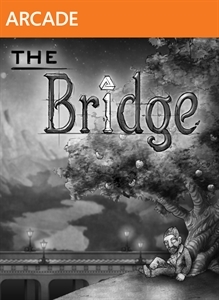
XBLA - The Bridge

Haiku-Review:

how Newton's "folly"
awakes the strand of nightmares;
validates the bridge

Additional Comments:

The Bridge is easily one of the best games I've come across in a while. Like a few other games that garnered my complete adoration: VVVVVV and Katamari Damacy, to name but two, The Bridge relies on a sole mechanic. Using the triggers, the player rotates each of the stages either to the left or right, up to and beyond a full 360°. Essentially, the game is nothing but a nightmarish stumble through a series of demented tilt-a-whirls somehow encapsulating the works of M. C. Escher and Edgar Allan Poe.

The game came as a recommendation thanks to Limbo. Immediately, the whole black and white presentation grabbed me. I don't know what it is, but the lack of color in some of these modern games adds so much value to the overall experience. For the brief moment we get to see The Bridge's countryside radiate the full spectrum of the rainbow, it's stunning for sure, but breaks the maddening emotion of the game. But then, it's obviously the point as the nightmare fades into the familiar domestication that is reality. A definitive dividing line between despair and comfort must exist, and so exists the bridge between grayscale and beautiful chroma.

While the color, or lack thereof, drew me in, as though I fell under the sway of flagrant advertising, the gameplay played the part of a hard-sell salesman. Despite the obvious ease of The Loft, the very first room in the game, I was hooked. I didn't even have to see that the game was a series of logic puzzles. I didn't care what it was. I was sold. Maybe it took The Library and The Menace to truly lay down the blueprints for what was to come, but it was nothing more than gravy by that point. Shades of VVVVVV crept into my mind even though I knew these two games were worlds apart. It was that gut feeling that The Bridge was going to take a single premise and run it through a wringer until every imaginable application can be established over the course of the game. And the Quantum Astrophysicists Guild managed just that with flying colors.

Even when The Bridge begins introducing additional nuances such as x-axis/y-axis reversal teleporters, positive/negative variants of certain objects including the player, dual personas, or temporal gravitational distortion fields (which I still had a hard time wrapping my head around at times), the game never deviates from its core mechanic. Each additional layer of complexity meshes perfectly with the initial gameplay, unlike most games where a multitude of ideas can lead to muddy or awkward gameplay, not to mention a torturous set of controls. The Bridge, however, keeps it clean no matter how much stuff gets thrown at you: rotate, activate, and if necessary, some time reversal.

My only complaint, which I should note was only an initial complaint, was that The Bridge lingered on the easy side. That is until I opened up the mirrored chapters. I knew they were coming, but wondered what they were actually going to bring to the table. After all, when I see the term "Mirror" I think of the Mario Kart series. It's not exactly an increase in difficulty - more that it feels difficult only because what's familiar is no longer familiar. Naturally, I could only assume padding at this point as it was difficult to imagine some of these levels, especially those that are symmetrical, mirrored. I couldn't have been any further from the truth in my assumptions. The levels start as such, with a minor tweak or two - The Loft for example - but the difficulty quickly ramps with a interesting assortment of tricks thrown together in a diabolical hodgepodge of agony. Chapters Six and Seven were especially nettlesome as there were a couple of rooms in each hall that definitely put me through the paces.

Where some real aggravation sparked, however, was in the wisp collecting and the Inverter achievement which took place on Mirrored Garden. I must have spent a good hour or so attempting completion with only five inversions. Thing is, when I finally managed it, I was dumbfounded by how simple the solution actually was, but for some reason, I just couldn't envision it. Same situation happened when trying to collect the wisp on Mirrored Menace, which I think might have taken top prize for giving me the most grief only because it had to be done without time reversal. Although, when it came down to it, that turned out to be the least of my worries. The first time I did the level, I exited with relative ease. However, when I returned to retrieve the wisp, those five menaces annihilated all hope to proceed. I couldn't even manage the exit door anymore and I think it took me somewhere between 30 minutes to a hour just to pull off that simple feat again. With that much trouble, having to dump all those toothy grins on one side of the triskele proved impossible, or damn near impossible. Still, the difficulty of these tasks never reached the point where I found it unbearable. Perhaps the whole logic aspect kept everything in check which is often the case in puzzle games. No matter how hard a puzzle may get, logic dictates there's always a solution. Same can be said for any game, but health, life or other gameplay mechanics can add multiple variables that often twists black and white scenarios commonplace to puzzle games into experiments in luck. And although The Bridge adds its own dastardly web of variables, it's still just a simple traverse from point A to point B puzzle game. Then again, those gravitational fields possibly add far more variables then necessary when starting to deal with positive/negative menaces. At that point, up, down, left, and right seem to revel in complete chaos.

I have a pretty good idea The Bridge isn't for everyone, but for anyone into puzzle games, or more accurately, platform-ingrained puzzle games, it's a must play. It demonstrates taking a simple mechanic to its extreme with gusto and dresses it all up in some sort of creepy mathematical nightmare. I love it! In fact, I'd love to see a followup. To help enhance the mood, the game is blessed with a perfect melancholic soundtrack. Chance of finding examples are slim to none, so it's all the more reason to just check the game out instead.

Rating: 5 Konami codes out of 5

Wednesday, December 25, 2013

SNES - Super Mario World

Haiku-Review:

a magical thrill,
or just a broken menace?
Feather? Yoshi!? Fie!!!

Additional Comments:

I feel there are two points I must state before I carry on:

1. Having, for the past four years, remarked on the Mario franchise come Christmas Day, I've found myself to be at a crossroads for next year. Where exactly does the Mario franchise go from here? Do I continue on with the Super Mario World nomenclature, i.e. what's commonly dubbed Yoshi's Island, or do I bound into the realm of 3D with Super Mario 64? Or, as a radical diversion, do I forgo several years of Mario madness and tackle New Super Mario Bros. on the DS? SMW2:YI seems the logical choice only because it's obviously meant to be a sequel if numbers are to be believed, however, from there, my next game would end up being Yoshi's Story - and so I've fallen out of the core franchise. I've never viewed Super Mario 64 as the sequel to SMW, at least in recent years, only because a definitive schism between the 2D platformers and the 3D free roams now exists. As such, Super Mario 64 feels more like an origin game. Of course, the Nintendo 64 botched all sorts of franchises when it came to sequels. NSMB, to me, seems the appropriate choice only because it follows the logic of the original 2D platformers. Sadly, NSMB Wii has already been commented on. Maybe I'll disregard all logical conclusions and play something from left field like Mario's Time Machine. Ugh.

2. Any reasonable comments I can dare make on this particular addition to the Mario franchise are sadly spoiled by my time within the SMWC community and urge to break its raw assembly code to bits. That is, at least those strings of code which I could manage to bust up on my own accord.

And so, without further adieu...

Super Mario World is a fantastic game - it's a broken game, but it's a fantastic game. I find that it often pops up in heated debates over which is better: SMB3 or SMW. It's a tough call - it really is. For me, SMB3 edges it out, and I think that's only because I managed far more replayability out of it over the years than SMW, although my time with SMWC would prove otherwise as I came to know the game as far more than just a game. I recall long nights pouring through its disassembly trying to figure out how this routine worked or other such nonsense. This may have both hindered and helped kindle my love for the game all the more. While I became far more intimate with the game than any other - even SMB3 - I also learned about all of the ugly programming Nintendo swept under the rug that not only made SMW a brilliant game, but an interesting romp through twisted malfunctions and botched tomfoolery. In short, this game suffers from some serious glitches, however, much like corrupting a game with say, a Game Genie, most, if not all of the glitching adds nothing but smiles and laughs. And wouldn't you know, most of the flawed gameplay is a direct result of either the feather or Yoshi. Heh.

But enough of the game's gremlins and their somehow amazing lack to cause detriment to the experience. Seriously, it's such a joy whenever I can pull off some of the unintended tricks with the feather. The game would have been well to do to be called Mario Air Show. Hmm, has that hack been made yet? If not, it should. I know how much people would detest it, as would I, but still worth the agony it would induce. Sheesh, an entire hack of levels similar to VIP's (^O^) Smooooth? No, thank you.

Being that it was the pack-in game, Super Mario World was the first game I got for the SNES. But my initial forays into the game took place on demo machines at various Sears. I remember one in particular where the game save had Mario exploring Chocolate Island and I was absolutely enthralled by the levels populated by running herds of Dino Rhinos and Dino Torches. But of course, like most, that one stand out moment was when I first stepped into Yoshi's Island 1 and saw a ballistic behemoth flying across the screen. I think it's great that Nintendo decided to drop an unexpected Banzai Bill in right from the get go as it allowed the SNES to show up the NES for what it really was. Never before had Mario faced such a magnificent menace, and I'm certain I can speak for so many of us who were lads in the 8-bit/16-bit era - our jaws were left hanging.

Super Mario World easily toppled all of those Mario games before it by sheer ingenuity. SMB3's overworld was awesome; seeing some of the various themes further expressed by localizing certain level icons added to the wonder of each world, such as the desert/pyramid levels in Desert Hill. SMW took the overworld a step further and compressed all the worlds into one giant map. Utilizing secret exits within numerous levels, the world quickly becomes a spider's web of available routes to Bowser. And while SMB3 also allowed for multiple pathways at times, it didn't exactly have the free-roaming feel that SMW dished up. Free-roaming may not be the best term, but there's definitely a feeling of personal freedom which up until this point has never existed in a Mario game. The only thing that's ever bothered me about SMW's overworld, however, is the lack of distinct world themes such as those found in SMB3, the Super Mario Land series or the NSMB series. Sure, it can be argued that themes exist: Vanilla Dome equates to cave levels; Twin Bridges, bridge levels; Forest of Illusion, forest levels etc., but it's not quite the same. When you take a step back and look at the whole world, the overlying theme appears to be generic grasslands with some spelunking thrown in here or some aquatic excursions thrown in there.

Moving into the levels themselves, there were some great ideas thrown about. I remember the first time I saw the fencing in Iggy's Castle and thinking how cool it was to flip from the foreground to the background. Too bad it never carried out its full potential; it was more a gimmicky aside. However, there were numerous other lifts, layer 2 gimmicks, and tricks that kept most all of the levels feeling fresh, even by the time you ticked off exit number 96. Add to that some interesting new abilities and Super Mario World is a solid platformer.

Unfortunately, over the years, certain aspects of the game have grown tiresome, but that's to be expected in any game. However, there's one aspect of SMW that seemed to take a bigger hit than most games and that's the boss fights. As a kid, I had no issue with them. I had no real reason to have issue with them as we had been given an assortment of boss fights that upped the ante on those found in SMB3. But there's something about the boss fights in SMW that instills a feeling of exasperation or boredom. Even with the Mode 7 effects, the Koopa kids feel hokey even though, fundamentally, they're really no different than the battles found in the various airships in SMB3. The Bowser battle is where the real eye-rolling happens though. Even today, when I play SMB3, the Bowser battle exudes excitement and a certain sense of anxiety. In fact, I still think it's one of the best Bowser battles out there. SMW's battle however is agonizing; not in it's difficulty, but how much waiting around takes place. Mario spends more time loitering than he does chucking Mechakoopas. I fully understand why Brutal Mario is (or was - not sure if it still has the same allure that it had circa 2008, but my guess is no) so appealing to so many noob ROM enthusiasts as it was one of the first hacks, if not the first, that ditched all the regular bosses for new, improved overlords.

And finally, there's the feather and everyone's beloved dinosaur, Yoshi. I love the feather. It's an incredibly overpowered item, but I love it nonetheless. It allows Mario to topple the world with total chaos in his hands. If you're inclined to disagree, watch any TAS of SMW and behold the unbridled power of that one item. Heck, just go watch an RTS to see what's capable by an actual player. Complete and utter anarchy! The downside is that it makes the game far too easy, however it's a blast exploring the levels and performing stunts Mario was never meant to perform. Yoshi, on the other hand, I don't care much for him. Never have. I know most people would decree blasphemy, but he's...just awful. I especially hate when certain secrets are reliant on him - actually, offhand, I can only think of one, but I know a number of hacks have increased Yoshi reliance tenfold. That more than anything may have led to my repudiation towards the reptile, but I know I've always been rather cold towards him. To me, he comes off as an annoyance. It's like Yoshi and baby Mario's relationship in Yoshi's Island - I have to do everything in my power to ensure that stupid infant is on my backside. Same here. Whenever I get Yoshi, my priorities become far more dino-based than they should be. Even though he's nothing more than a walking springboard with some extra life insurance, I feel as though I must ensure his safety for as long as humanly possible. Instead of letting him run free through the fields, I find myself scampering after him. Just let him go. In my opinion, Yoshi can be summed up in two words - two words eloquently spoken by the long-running Mario aficionado: Raocow.

"Stupid horse!"

All that remains, I suppose, is the music. Honestly, I can go either way with the music. The soundtrack, like all the Mario games that came before, is fantastic. And although they're short, the overworld themes have always had the most poignant melodies - hmm, much like SMB3. In fact, Forest of Illusion and Vanilla Dome may be two of the best tracks in the game. However, much like the boss fights or a few other certain aspects of the game, the music has grown dull over time, which again can be attributed to my time at SMWC and having to hear the same themes over and over again. If I had never stumbled across the ROM and/or hacking communities, the likelihood of becoming so disinterested in the soundtrack would have diminished exponentially, or even be consider moot altogether. I suppose there's pros and cons to modifying a game in hopes of extending its shelf-life. Eventually, even some of the much loved aspects of the game will become nothing more than cause for bellyaching. C'est la vie.

Nevertheless, Super Mario World is an amazing game and an incontestable must play for any avid gamer. It's one of the best Mario games out there, although I will always tout Super Mario Bros. 3 as the.superior title. So, go out, rescue those eggs and bring Bowser crashing to his knees!

Rating: 5 ameliorated hillocks out of 5

Tuesday, December 17, 2013

SCD - Vay

Haiku-Review:

shalt we cross the sea
upon yon maiden's ill wind -
ships are so passé

Additional Comments:

I can't believe I managed two games in a row that placed needless emphasis on breaking wind at one point or another. At least Vay was at worst a little cheeky while Fable was flat out immature. But I digress....

First off, I can't believe it's taken me this long to get a Sega CD title up on Beat All Games. I was floored when I bought one a couple years ago and couldn't wait to start playing some games on it. Growing up, I had a friend that had a Sega CD - bought it right about when it came out. I remember he had a few games, but the only one I vividly recall was Sewer Shark. What a horrible mess that was. Even with Sewer Shark as my only point of reference all these years later, I was still utterly fascinated by the system. A majority of the games seem to be nothing more than crap, FMV-based crap, or ever-so-slightly enhanced versions of Genesis games. There's really nothing to get excited about, not to mention the system itself is pretty dodgy - especially the Rev. 1 which is what I have. However, there is a treasure trove of gems mixed in there if you know where to look. Looking around the net, I kept seeing Vay pop up as one such title. First thing that caught my eye was the Working Designs logo as they've often picked up some genuinely amazing titles and brought them to the US. Unfortunately, like most Working Designs games, they're not exactly cheap or easy to come by. Yea, still trying to track down an SCD Popful Mail for a fair price.

Popped in the disc and instantly I felt like I watching some old Ralph Bakshi production. The narrator's exasperated, almost decrepit tone brought back visions of Wizards and while the animation is more of a montage of choppy stills with clearly pixelated imagery, a certain semblance gave merit to the game's cutscenes as a long lost relative of Bakshi's design. Sadly, like most games in the early "real audio" days, the voice over work leaves much to be desired. Even the initial narration, despite it's ability to cull old movies from memory, allowed for some eye-rolling. It works, but there's an obvious call for overacting thrown in the script notes. Although it's nowhere near as outrageous as any of the later scenes, especially anything involving death.

As for the game itself, it's a basic turn-based RPG. The key word here is basic. This is one of the most stripped down, bare-boned RPG's I've ever seen. Vay makes the original Final Fantasy look complex. That's not entirely true - the two games are pretty comparable as far as depth and detail. If anything, Vay has a much more engrossing story, even if it's completely predictable, but the gameplay is broken down to the absolute essentials and is reliant on linear progression. I'm not saying linear progression is necessarily bad, as I'm not the biggest fan of games going gung ho with side quests, but Vay felt like it was on rails. For example, having just come off Final Fantasy II as well, that game is completely linear, but it never felt like I was being guided involuntarily every step of the way. A little exploration could have benefited this game greatly. The continents are essentially corridors barring any real freedom of movement. The only area void of any sense of claustrophobia was likely Penan, where in fact it took a good while to find Vaygess and then somehow lost track of it after my first explorations into the cavern of the Maytake. But given how necessary grinding is in this game, I welcomed these two strayed excursions with open arms.

After wrapping up Final Fantasy II, it was so refreshing to play an RPG where grinding wasn't the prevalent theme. Sadly, the idea that an RPG should be properly balanced was eviscerated beyond recognition as Vay championed grinding tooth and nail. However, it didn't rear its ugly head until Raxaal, therefore leaving me to believe I was playing another fairly balanced RPG. And I'm not referring to RPG's where death is an impossibility; where I should be able to sweep every floor clean on my first excursion. I expect death, but I don't expect to fall into the usual infinitesimal heal cycles that plague so many other RPG's, at least not on common dungeon cretins. I'll give some slack for bosses, though even there I disagree with the mechanic, but it's ridiculous to blow all your mana on heals after every single battle. The obvious answer is the characters are too weak for that particular point, but up until that point the difficulty grade has been a constant diagonal. Suddenly, it's a giant awkward step, and this happened numerous times throughout the game which resulted in tedious grinding. On a few occasions, namely Treefall, Sentinel, and Danek, I spent anywhere form several hours to a couple days just battling random encounters so my characters were at an acceptable level to take on the required foes ahead.

On a side note, I also spent a few hours grinding after the Danek Base near Mortyr, but did so voluntarily as I hate having all my characters level up at the same time. That's just something that's always annoyed me in RPG's. Essentially, I purposefully killed off half the party or all but Sandor and wrestled a variety of monsters on the overworld until I felt the levels were staggered enough. I know it sounds like I'm just handicapping myself, but trust me, it's not. If anything, it's additional free experience for one or two characters.

Another reason grinding stands out in this game is that the experience gaps between levels are absurd, yet the experience payout never really increases until the very end of the game. Holy shit, kill a Flea Bag and you'll score one hell of an incredible payout. Too bad 99% of those things flee from battle all the time. This is one reason I initially staggered my character's levels and collected experience. Instead of having all four characters wait 100k XP before they level, I have a character leveling every 25k or what have you. For me, there's a greater overall relief if I can have a character level at fairly regular intervals, especially in this game since both the character's HP and MP are reset. I found I could suffer dungeons for far longer because I knew that at least after every 10 or 20 battles, someone's going to level. This additionally helped with battle strategy as far as spells were concerned. Do I really need to cast Restore or Panacea? No, cast a couple Balms if necessary and feed all that MP into a series of Malybu's. By the time I run out of MP, Bam!, leveled up. Otherwise, I'd be counting a long succession of turns before I can improve the party's outlook. Either that or epic usage of Alakazam. Ugh. I hate using any sort of teleportation in any game I play although I'll admit that I succumbed to Alakazam about a half dozen times in Danek as I was grinding out experience. Just another odd quirk about how I personally play games. Heh, if the game made better use of treasures, I would have followed my no shopping rule as well.

However, for having at best an elementary presentation and deliberately focusing on endless grinding, I enjoyed the game thoroughly. Whenever I'm tasked with leveling chores, I typically grow bored and throw the game aside - main reason I steered clear from RPG's for so many years. But here, it never overwhelmed me with needless tedium. Somehow, the game managed to keep my interest going no matter how menial my play sessions became. In some respects, I found this game comparable to 7th Saga - sort of a "fun for all the wrong reasons" experience. And by the time I reached Danek, I felt rewarded for keeping at it just to behold the dark and twisted imagery of that castle alone. Maybe it was the grinding itself - having to toil through throngs of evil denizens for so little gain - that helped keep the interest alive. After all that hard work, I felt a sense of accomplishment every time I tackled the next monstrous obstacle. I know this was especially true for Sentinel and Danek. Hmm, perhaps grinding is a necessary evil after all, but I hesitate to make such a claim as I still feel the idea to be complete bollocks.

Would I recommend the game? Maybe as a worthwhile title for any Sega CD fans, otherwise, no. Vay's a great game, don't get me wrong, but there's no real sense of innovation. There's nothing there that hasn't been seen before in your Final Fantasies, your Dragon Warriors, your Phantasy Stars or countless other 8-bit/16-bit turn-based RPG's. For a fan, sure, why not? Otherwise, it's best to spend that Working Designs size chunk of change elsewhere.

There is some wonderful music tucked in there though. Personal favorites include the Village Theme and Welcome to the Caves (love the digital analog growl at the end of the song). Top honors, however, would have to go to Freak You Out. This song fits perfectly with the nightmarish aesthetics in and around Danek. In fact, I often found myself resting among the bones and horrifically mutilated wall faces just to take in the chilling music the emperor consistently pumped through his castle's halls. Not to mention, it had a kitschy Michael Jackson motif that kept kicking in every now and then. Come to think of it as I find myself listening to all of the music on offer again, I have to say the entire soundtrack is pretty damn solid, which again appears to be a common theme among Working Designs' games.

Nano-Rant:

I was gravely disappointed that I couldn't make use of the casino in Vaygess despite so many NPC's talking the place up. Under most circumstances, I wouldn't even care, but given that some local proprietor's magic chest suddenly defunded my entire wallet, it would have been a nice change of pace to help alleviate my sudden bankruptcy woes.

Nano-Relief:

After about four hopeless turns against Sadoul, thank goodness I suddenly remembered Thyxaal's purpose. I foresaw that battle going south real fast.

Rating: 4 Eediots out of 5